
Certified for Safety. Trusted by Leaders Worldwide.
Pls inquire to sales@danddhardware.com
\\: +86 139 2903 7292

 English
 Author: Site Editor Publish Time: 2026-08-10 Origin: Site


Supermarkets and shopping malls require door hardware that serves two competing demands: robust overnight security and frictionless customer flow during business hours. The right combination of mortise locks, fire rated door hardware, and door closers allows facility managers to meet both needs without compromise — protecting assets after closing while ensuring safe, smooth access throughout the day.
D&D Hardware Industrial Co., Ltd. — a CE, UL, ANSI, and BHMA certified manufacturer with 18 years of OEM experience — offers a complete range of door hardware solutions specifically suited to the varied door types found across shopping centers and retail environments.
Shopping malls and supermarkets typically require three distinct categories of door hardware, each matched to a specific zone and risk level:
High-security mortise locks for main entrances and perimeter doors
Narrow stile mortise locks for glass storefront doors inside the mall
Fire rated door hardware and panic exit devices for rear service corridors and emergency egress points
Each zone has different priorities — main entrances prioritize anti-theft security after hours; glass store doors require hardware that fits slim aluminum frames without sacrificing strength; and back-of-house passages must comply with fire and life-safety codes while enabling rapid evacuation.
Standard residential or light commercial locks are not engineered for the operational demands of a supermarket or shopping mall. Consider the daily load: a busy shopping center may see tens of thousands of door cycles per day across dozens of entry points. Hardware that lacks heavy-duty ratings will wear prematurely, create maintenance liabilities, and — more critically — fail at the moment security matters most.
Retail facilities should specify hardware rated for high-cycle commercial use, certified to recognized international standards, and matched precisely to each door type and application zone.
The main entrance of a supermarket or shopping mall is the highest-priority security zone. During business hours, these doors must handle constant, high-volume traffic smoothly. After closing, they must resist forced entry and unauthorized access.
A high-security mortise lock is the preferred solution for main entrance doors because:
The lock body is embedded within the door leaf, making it significantly harder to defeat than surface-mounted alternatives
Multi-point locking options provide additional resistance against kick-in or prying attacks
Certified stainless steel core locks offer corrosion resistance and long service life in high-humidity retail environments
D&D Hardware's stainless steel mortise locks — available in both American and European configurations — are designed to meet ANSI, BHMA, and EN12209 standards, making them suitable for the demanding main entrance environment of any shopping center or supermarket.
Door Closer Pairing: Main entrance doors in shopping malls should be paired with a heavy-duty commercial door closer to ensure controlled, consistent closing under high traffic volumes. D&D Hardware's UL-listed door closers provide adjustable closing speed and back-check functions, protecting both the door hardware and passing customers.
Glass storefront doors inside a shopping mall present a unique hardware challenge: the aluminum or glass door frames are too narrow to accommodate a standard mortise lock body.
A narrow stile mortise lock — sometimes called a narrow backset lock — is specifically engineered for this application. Key features to look for include:
Reduced backset dimension (typically 20–35 mm) to fit slim aluminum extrusions
Multi-point locking for glass doors, which are inherently more vulnerable than solid-core alternatives
Aesthetic compatibility with glass and aluminum finishes common in retail design
D&D Hardware's narrow door frame lock range precisely addresses the dimensional and functional requirements of glass storefront doors in shopping malls and shopping centers. These locks maintain strong security performance within the spatial constraints of glass door hardware applications. Explore D&D's glass door hardware range for compatible components.
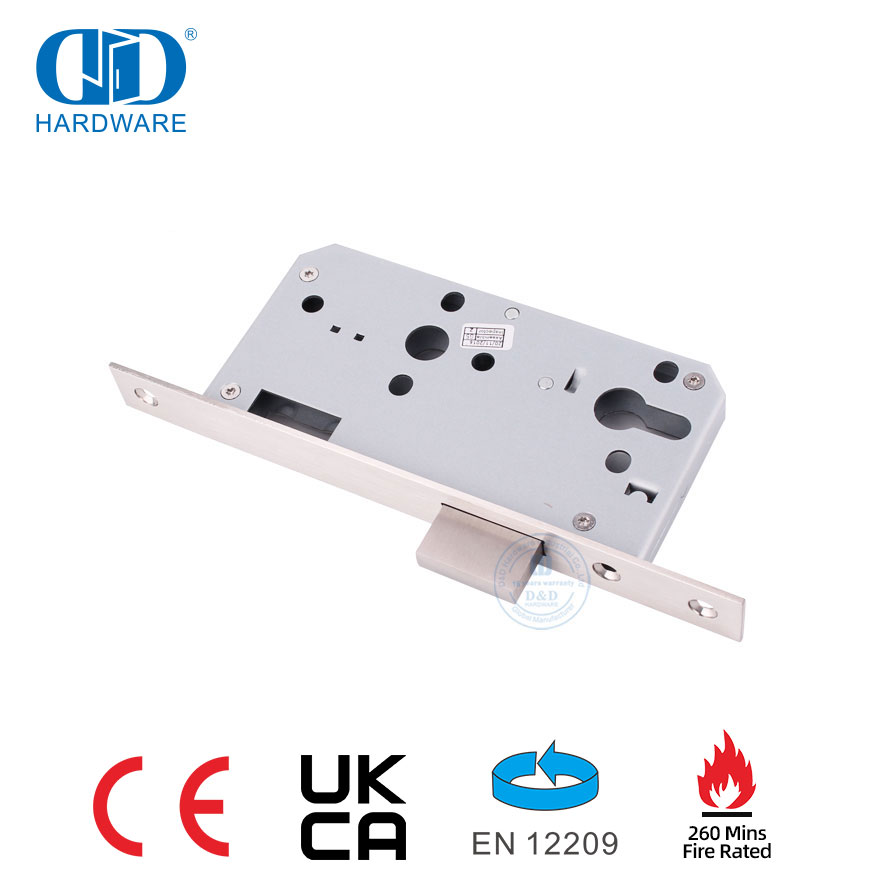
Fire rated door hardware is not optional in shopping malls and supermarkets — it is a code requirement. Rear service corridors, loading dock access points, and emergency exit routes must be equipped with hardware that maintains the fire rating integrity of the door assembly and guarantees reliable egress under emergency conditions.
The core components required for fire rated doors in retail settings include:
Fire rated mortise lock or panic exit device: Must be UL 10C listed to confirm positive pressure fire testing compliance. A panic bar (push bar / fire exit hardware) is typically required on egress doors serving high-occupancy areas, allowing single-motion exit without prior knowledge of the device.
Fire rated door closer: Holds the door in a normally closed position, ensuring the fire barrier remains intact between evacuation events. D&D Hardware's UL 10C-listed door closers are tested for performance under fire conditions and rated for heavy-duty commercial use.
Fire rated hinges: The full door assembly — lock, closer, and hinges — must be rated as a system. D&D Hardware offers ANSI/UL/BHMA certified door hinges compatible with fire door assemblies.
A common specification error in shopping mall projects is sourcing fire door hardware components from multiple suppliers without verifying system-level fire rating compatibility. Specifying a complete, certified fire door hardware set from a single manufacturer — such as D&D Hardware — reduces this risk and simplifies compliance documentation.
A door closer in a retail environment must balance two functions: reliable automatic closing (critical for fire doors and climate control) and resistance to damage from high-frequency use.
When specifying a door closer for a supermarket or shopping mall, consider:
Grade/size rating: Heavy-duty commercial closers (typically EN 3–6 or ANSI Size 4–6) are appropriate for high-traffic retail doors
Adjustable closing and latching speed: Allows fine-tuning to avoid slamming while ensuring the latch engages reliably
Back-check function: Prevents door damage when opened forcefully — essential on busy entrance doors
Hold-open function: Useful for loading dock and service corridor doors during delivery hours
UL listing: Required for door closers installed on fire rated door assemblies
D&D Hardware manufactures both overhead door closers and floor spring closers to suit different door types across the shopping center environment, all available with UL listing for fire door applications.
Application Zone | Recommended Lock Type | Key Certification | D&D Solution |
|---|---|---|---|
Main entrance (solid/metal door) | High-security stainless steel mortise lock | ANSI / EN12209 | |
Glass storefront (narrow stile) | Narrow stile mortise lock | CE | |
Fire exit / rear corridor | Panic exit device + fire rated mortise lock | UL 10C | |
All fire rated doors | Fire rated door closer | UL 10C |
A high-security mortise lock is better suited for solid-core main entrance doors where anti-theft resistance after hours is the primary concern. A narrow stile mortise lock works best when the door frame profile physically cannot accommodate a standard backset dimension — a situation common across glass-fronted retail units inside shopping centers. Fire rated door hardware, including panic exit devices and fire door closers, is mandatory wherever the door forms part of a rated fire compartment boundary.
D&D Hardware Industrial Co., Ltd. has supplied door hardware to commercial construction projects worldwide for nearly two decades. For shopping mall and supermarket applications specifically, D&D offers:
Certified hardware across all required categories: CE, UL, ANSI, and BHMA certifications cover mortise locks, door closers, fire exit hardware, hinges, and lock cylinders — enabling single-source specification across the entire project
Narrow stile and standard mortise lock options: D&D's product range covers both the perimeter security requirements of mall main entrances and the dimensional constraints of internal glass storefront doors
ISO 9001 certified manufacturing: Consistent quality control from an ISO 9001 certified factory, with 18 years of OEM experience supplying globally recognized brands
Factory-direct pricing: Direct manufacturer supply eliminates distributor markups, reducing procurement costs on large-scale retail projects
Technical project support: D&D's team provides specification support for complete door hardware schedules across complex, multi-zone commercial projects
Explore D&D Hardware's full door solution range or review project solutions for reference applications similar to your shopping mall or supermarket project.
Q: What type of mortise lock is best for a supermarket's main entrance?
A: A heavy-duty stainless steel mortise lock with ANSI or EN12209 certification is recommended for supermarket main entrances. These locks embed within the door leaf for superior forced-entry resistance and are built to withstand the high cycle counts typical of busy retail entry points. After-hours security is the primary design driver for this zone.
Q: Do glass storefront doors in shopping malls need special locks?
A: Yes. Glass storefront doors in shopping malls typically use aluminum narrow stile frames that cannot accept a standard mortise lock backset. A narrow stile mortise lock — engineered with a reduced backset dimension — is the correct specification. These locks maintain commercial-grade security within the spatial constraints of glass and aluminum door systems.
Q: Is a door closer required on fire rated doors in a shopping mall?
A: Yes. Fire rated doors must be equipped with a UL 10C-listed door closer to ensure the door returns to its closed, latched position after each use. An open or improperly latched fire door compromises the fire compartmentation of the building. Many jurisdictions also require that fire doors on egress routes be fitted with panic exit hardware to allow single-motion exit.
Q: Can I source mortise locks, door closers, and fire exit hardware from one supplier for a mall project?
A: Yes, and doing so is recommended for system-level fire rating compliance and specification consistency. D&D Hardware supplies certified mortise locks, door closers, panic exit devices, hinges, and glass door hardware from a single ISO 9001 certified factory, simplifying procurement and compliance documentation for large retail projects.
Q: How many door cycles should commercial door hardware in a shopping mall be rated for?
A: High-traffic retail environments typically require hardware rated for a minimum of 1,000,000 cycles for main entrance applications. Specifying hardware to ANSI Grade 1 or BHMA Grade 1 standards — or the equivalent CE heavy-duty classification — ensures the product is tested for this level of commercial use. Always confirm cycle ratings with your hardware supplier during the specification stage.
For project specifications, OEM inquiries, or technical support, contact D&D Hardware at sales@danddhardware.com or visit www.dnd-hardware.com.


