
Certified for Safety. Trusted by Leaders Worldwide.
Pls inquire to sales@danddhardware.com
\\: +86 139 2903 7292

 English
 Author: D&D HARDWARE Publish Time: 2026-06-17 Origin: D&D HARDWARE


Quick answer:
Commercial door lock compliance requires meeting three overlapping frameworks: ADA standards (one-hand operation, max 5 lbs of force), fire code requirements (no key-locked emergency exits, UL-listed hardware on fire-rated doors), and ANSI/BHMA Grade 1 certification for high-traffic durability. Non-compliance can result in failed inspections, legal liability, and—most critically—compromised occupant safety.
Selecting a door lock for a commercial building is rarely a simple procurement decision. For construction contractors, property managers, and facility managers, the wrong lock can trigger failed building inspections, costly retrofits, ADA lawsuits, and fire code violations that put lives at risk.
Three compliance frameworks govern commercial door locks in the United States: the Americans with Disabilities Act (ADA), local and national fire codes (primarily NFPA 101 and IBC), and the ANSI/BHMA grading system. Each targets a different dimension of lock performance—accessibility, emergency egress, and mechanical durability—and all three must be satisfied simultaneously.
This guide breaks down what each standard actually requires, where they intersect, and how to choose a compliant commercial door lock from the outset rather than fixing problems after installation.
ADA compliance for door locks is defined under the ADA Standards for Accessible Design, specifically Section 404.2.7 on door hardware. The rules are straightforward but frequently overlooked during procurement.
Key ADA requirements for commercial door locks:
One-hand operation: Locks must be operable with a single hand. This immediately disqualifies double-cylinder deadbolts and knob-style locks that require tight grasping or twisting.
Maximum 5 pounds of force: The hardware must not require more than 5 lbf to operate. This threshold protects individuals with limited grip strength or upper limb disabilities.
Mounting height: Lock hardware must be mounted between 34 and 48 inches above the finished floor.
Lever handles preferred: Lever-style handles satisfy the one-hand, no-twist requirement far more reliably than round knobs.
A common compliance error is specifying a high-security cylindrical knob lock on an accessible route. Even if the lock's security rating is excellent, a knob that requires grasping and rotating fails ADA requirements outright.

The practical implication: any door on an accessible route in a commercial building—including office entries, restrooms, conference rooms, and common areas—must use ADA-compliant hardware.
Fire code compliance for commercial door locks is primarily governed by NFPA 101 (Life Safety Code) and the International Building Code (IBC), both of which are adopted (with local amendments) by most U.S. jurisdictions.
No. NFPA 101 explicitly prohibits locking emergency exit doors in a way that requires a key, tool, or special knowledge to open from the egress side. This is one of the most enforced—and most violated—requirements in commercial buildings.
Core fire code requirements for door locks on commercial buildings:
Emergency exits must be freely openable from the inside without a key. Panic bars (exit devices) are the standard solution for these doors.
Fire-rated door assemblies require hardware that is specifically tested and listed for use on fire-rated doors. Using a non-listed lock on a fire door voids the assembly's fire rating, even if the door itself is certified.
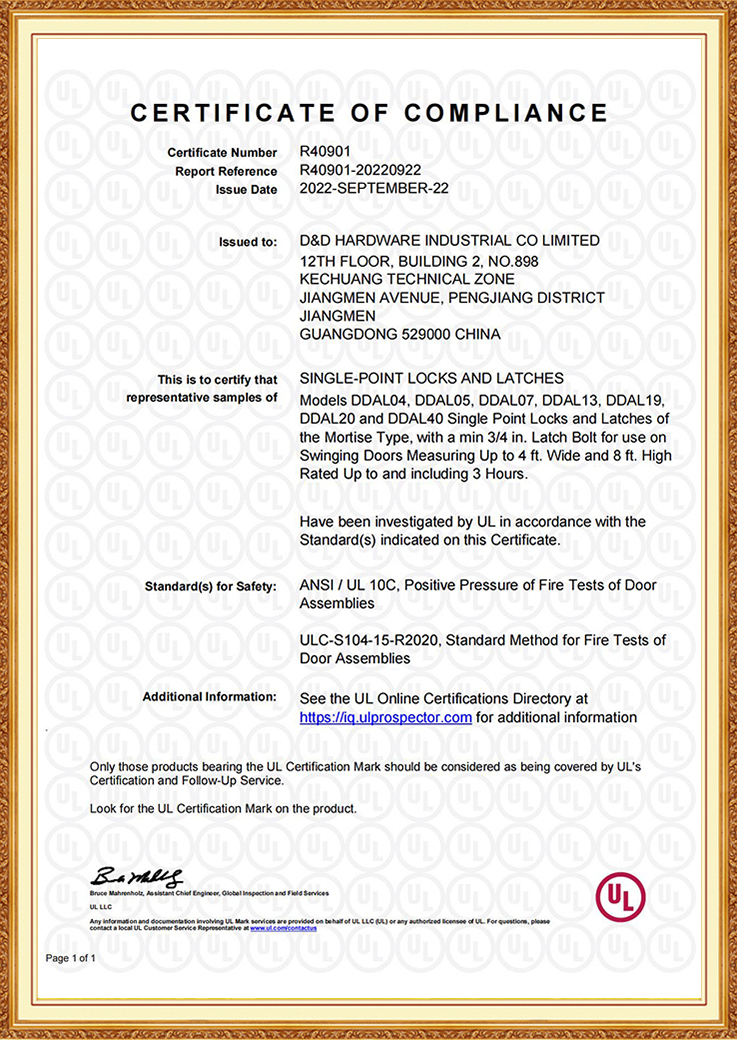
UL 10C listing (Positive Pressure Fire Tests of Door Assemblies) is the benchmark for locks installed on fire-rated doors. Hardware bearing this listing has been tested under the pressure conditions created by a building fire, not just ambient conditions.
Delayed egress locks are permitted under NFPA 101 in limited occupancy types (certain high-risk or security-sensitive facilities), but they require an alarm, a maximum 15-second delay, and specific signage.
The intersection of fire code and ADA is particularly important at exit stairwells and egress corridors, where the lock must simultaneously allow free egress (fire code) and be operable with one hand and minimal force (ADA).
The ANSI/BHMA (American National Standards Institute / Builders Hardware Manufacturers Association) grading system evaluates the mechanical performance and durability of door locks under ANSI/BHMA A156 standards. Three grades exist:
Grade | Intended Use | Cycle Test Requirement |
|---|---|---|
Grade 1 | Heavy commercial / high traffic | 250,000 cycles |
Grade 2 | Light commercial / multi-family | 150,000 cycles |
Grade 3 | Residential | 100,000 cycles |
ANSI/BHMA Grade 1 door locks are the minimum standard for most commercial applications. Grade 1 locks are tested to withstand 250,000 operational cycles—roughly equivalent to decades of use in a high-traffic commercial environment. They also undergo impact resistance tests (a 75 lb sandbag strike) and finish durability tests.
For construction contractors specifying hardware packages, and for procurement managers sourcing door locks for commercial buildings at scale, Grade 1 certification is a non-negotiable baseline. Specifying Grade 2 or Grade 3 hardware in a commercial context to cut costs almost always results in premature failure, warranty claims, and the expense of mid-lifecycle replacement.
ANSI/BHMA certification is verified through independent third-party testing—manufacturers cannot self-certify. Always request the certification documentation, not just a manufacturer's claim.Door Lock for commercial building

These three frameworks don't exist in isolation—they stack. A single door in a commercial building may need to simultaneously satisfy all three:
A fire-rated stairwell door must use a UL-listed lock (fire code), allow free egress without a key (NFPA 101), be operable with one hand and ≤5 lbs of force (ADA), and meet Grade 1 durability (ANSI/BHMA) given the frequency of use.
A main building entry on an accessible route requires a lever-handle lock (ADA), Grade 1 certification for traffic volume (ANSI/BHMA), and may require an exit device or specific latching hardware if it serves as a designated egress path (fire code).
The most defensible procurement approach for B2B buyers is to source hardware that holds all relevant certifications simultaneously—UL listing, ANSI/BHMA Grade 1, and ADA-compliant design—rather than verifying each compliance layer independently across different suppliers.
D&D Hardware manufactures commercial door locks carrying CE, UL, and ANSI/BHMA certifications, designed specifically for the compliance requirements contractors and facility managers face on commercial projects. Their product range includes mortise locks, panic exit devices, and door closers built for fire-rated and ADA-accessible door assemblies. You can explore their certified commercial door lock range at dnd-hardware.com.
For contractors and facility managers, a practical pre-purchase checklist:
Confirm the door's fire rating. If the door is fire-rated, the lock must carry a matching UL listing (e.g., UL 10C). No exceptions.
Identify whether the door is on an accessible route. If yes, confirm lever-handle operation, ≤5 lbf actuation force, and correct mounting height.
Specify ANSI/BHMA Grade 1 for any door in a commercial building with regular use.
Request certification documentation from the supplier—third-party test reports, not self-declarations.
Check local amendments. State and local jurisdictions often adopt NFPA 101 and IBC with modifications. Confirm the applicable edition and any local amendments with your AHJ (Authority Having Jurisdiction).
Review the full door assembly. A compliant lock on a non-compliant frame or door voids the assembly's rating. Hardware compliance must be assessed at the assembly level.
ADA-compliant door locks for commercial buildings must be operable with one hand, require no tight grasping or twisting, and exert no more than 5 pounds of force to operate. Lever handles are the most common ADA-compliant solution. Round knobs, double-cylinder deadbolts, and slide-bolt locks generally do not meet ADA requirements on accessible routes.
No. Under NFPA 101 and the IBC, fire exit doors must be openable from the egress side without a key, tool, or special knowledge. Panic bars (exit devices) are the standard compliant solution. Keyed locks on fire exits are a code violation and create serious life-safety liability.
ANSI/BHMA Grade 1 is the highest durability rating for door locks under the ANSI/BHMA A156 standard series. Grade 1 locks are tested to 250,000 operational cycles and undergo impact and finish durability testing. While not every jurisdiction mandates Grade 1 by code, it is the industry-standard specification for commercial door locks in high-traffic applications. Specifying a lower grade in a commercial context typically leads to premature failure.
Not automatically. UL listing for a door lock (such as UL 10C) certifies fire performance only. ADA compliance and ANSI/BHMA grading are separate certifications. A lock used on a fire-rated door in a commercial building may need to satisfy all three simultaneously. Confirm each certification independently with the manufacturer.
Request third-party test reports issued by accredited testing laboratories—not just a certificate image from the supplier. UL certifications can be verified through UL's online Product iQ database. ANSI/BHMA certifications should reference the specific standard (e.g., A156.13 for mortise locks) and the certifying body. Established manufacturers like D&D Hardware provide full certification documentation as standard practice.

Door lock compliance is not a box to check at the end of a project—it's a specification decision made at the start. Retrofitting non-compliant hardware after installation is expensive. Failing an inspection delays occupancy. And a lock that compromises fire egress or blocks accessibility carries consequences that go well beyond budget.
The clearest path to compliance is sourcing commercial door locks that arrive pre-certified to ANSI/BHMA Grade 1, UL fire-rating standards, and ADA-compatible design. For construction contractors, property managers, and facility managers working at scale, that means partnering with a manufacturer who can provide documentation—not just product claims.
Contact D&D Hardware at dnd-hardware.com to request specifications and certification documentation for their commercial door lock range.
Click here for additional details on door locks.
Now contact us.
Contact information for David Jian
Contact number: 0086-139 2903 7292
Email address: sales@danddhardware.com


