
Certified for Safety. Trusted by Leaders Worldwide.
Pls inquire to sales@danddhardware.com
\\: +86 139 2903 7292

 English
 Author: D&D HARDWARE Publish Time: 2026-07-09 Origin: D&D HARDWARE


A school door lock is a security hardware component installed on classroom, corridor, or campus entry doors to control access, protect occupants, and meet fire and safety codes. For educational institutions, selecting the right door lock is not a cosmetic decision — it is a life-safety one.
D&D Hardware Industrial Co., Ltd. is a China-based door hardware manufacturer with over 18 years of experience supplying CE, UL, ANSI, and BHMA-certified locks for commercial and institutional applications, including schools, universities, and training centers. D&D Hardware's education door lock solutions are engineered for high-traffic durability, code compliance, and rapid lockdown capability.
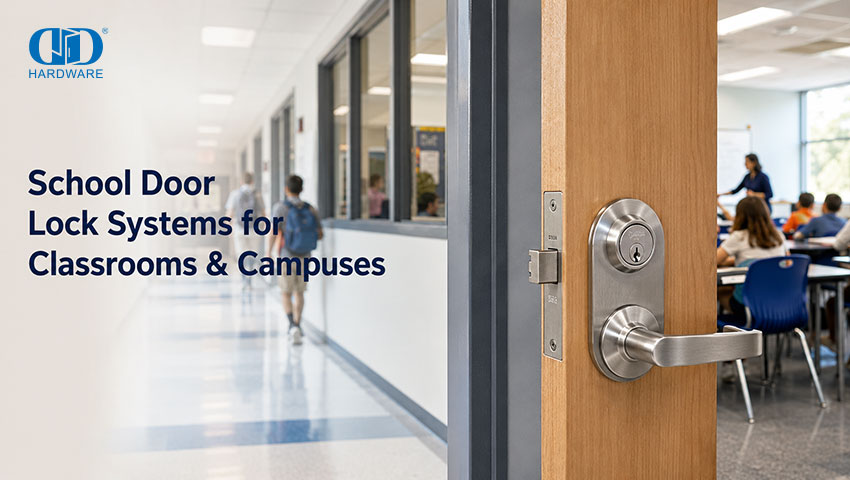
School door locks must satisfy overlapping requirements that standard residential or commercial locks do not. A classroom door lock must allow teachers to lock a door quickly from the inside during an emergency, comply with fire egress codes, withstand thousands of daily cycles, and remain operable by students of varying ages and abilities.
Institutions that select general-purpose hardware without considering these factors risk code violations, increased maintenance costs, and — most critically — delayed response during security incidents.
Key requirements for an educational institution door lock include:
•Lockdown capability: Teachers must be able to secure a door from the inside without entering the corridor
•ADA compliance: Hardware must be operable with one hand and require no more than 5 lbs of force
•Fire code compliance: No key-locked exits; UL-listed hardware required on fire-rated doors
•ANSI/BHMA Grade 1 rating: Mandatory for high-traffic institutional use
•Durability: Minimum 250,000 cycle ratings for classroom and corridor doors

Different areas of a school campus require different lock types. The table below outlines the most common zones and their recommended hardware:
The classroom is the most critical lockdown zone in any school. A classroom door lock should allow immediate interior locking without a key. Mortise locks with a classroom function (key locks from outside, thumb-turn or lever locks from inside) are the most widely specified solution for this application. D&D Hardware's mortise lock range includes models with classroom functions suitable for both American (ANSI) and European (EN12209) standards.


Main campus entrances require ANSI Grade 1 mortise locks or heavy-duty cylindrical locks with access control compatibility. These doors handle the highest daily traffic volume and must integrate with keycard, PIN, or biometric systems where access control is in use.
All fire corridor and emergency exit doors in educational buildings must be fitted with panic exit devices (also called panic bars or push bars). These devices allow free egress from the inside at all times while preventing unauthorized entry. D&D Hardware's UL-listed panic bar range is specifically designed for fire-rated door applications.
Large-occupancy spaces require panic hardware rated for high crowd loads. Concealed vertical rod or surface-mounted panic devices are commonly specified for double-door assemblies in these areas.
Standard mortise or cylindrical locks with key-only access are appropriate for low-traffic, staff-restricted areas such as server rooms, supply closets, and equipment storage.
An education door lock should carry the following certifications to be considered compliant for institutional use:
ANSI/BHMA Grade 1 – The highest commercial grade rating; required for high-traffic school doors
UL Listed – Required for locks installed on fire-rated doors (UL 10C for fire door hardware)
CE Marking – Required for educational institutions in the European Union and many export markets
ADA Compliant – Required under the Americans with Disabilities Act for all public educational facilities in the United States
D&D Hardware holds CE, UL, ANSI, and BHMA certifications across its door lock product range, making its hardware eligible for specification in educational projects across North America, Europe, and international markets.
When specifying a school door lock, procurement managers and facilities teams should evaluate hardware against the following criteria:
Classroom lockdown function: Confirm the lock can be secured from the inside without a key
Cycle durability: Look for ANSI Grade 1 ratings (250,000+ cycles minimum)
Material grade: Specify stainless steel or heavy-gauge zinc alloy for high-traffic doors
Vandal resistance: Institutional hardware should resist tampering and forced entry
Key control compatibility: Master key systems are standard in campus environments; confirm compatibility
Fire rating: Doors on fire-rated assemblies require UL-listed hardware
ADA operability: Lever handles are ADA-compliant; round knobs are not
D&D Hardware Industrial Co., Ltd. has supplied door hardware to commercial and institutional projects globally for over 18 years. For educational institution door lock projects, D&D Hardware offers:
OEM manufacturing: Custom hardware solutions tailored to project specifications
Full certification coverage: CE, UL, ANSI, BHMA, and ISO 9001 certified production
Factory-direct pricing: Eliminates middlemen, reducing procurement costs for large campus projects
Global shipping: Worldwide logistics support for international school and university projects
Technical project support: Design guidance and complete hardware set solutions available
D&D Hardware's door lock range includes mortise locks, cylindrical locks, panic exit devices, lock cylinders, and door closers — all the components required for a complete educational building door hardware specification.
View D&D Hardware's Door Lock Range | Contact D&D Hardware for a Project Quote

Q: What type of door lock is best for classroom lockdowns?
A: A classroom-function mortise lock is the most widely recommended solution. It allows a teacher to lock the door from the inside using a thumb-turn or interior lever, without needing to open the door or use a key. This function is specifically designed for lockdown scenarios and is available in ANSI Grade 1 ratings for institutional durability.
Q: Are panic bars required on school doors?
A: Yes. Under most national and local fire codes, panic exit devices (panic bars) are required on all fire-rated egress doors in educational buildings, including emergency exits, gymnasium exits, and fire corridor doors. These devices must allow free exit from the inside at all times. UL-listed panic bars, such as those offered by D&D Hardware, are required on UL-rated fire door assemblies.
Q: What is the difference between ANSI Grade 1, Grade 2, and Grade 3 door locks?
A: ANSI/BHMA grading classifies door locks by durability and security performance. Grade 1 is the highest rating, required for heavy-duty commercial and institutional applications such as schools. Grade 2 is suitable for light commercial use, and Grade 3 is for residential applications only. Educational institution door locks should always specify ANSI Grade 1 hardware.
Q: Can D&D Hardware supply a complete door hardware set for a school project?
A: Yes. D&D Hardware provides complete door hardware sets for educational and commercial projects, including locks, hinges, door closers, panic bars, and accessories. Technical project support is available to assist with hardware specification and design. Contact D&D Hardware at sales@danddhardware.com or via the contact page for a project consultation.
Q: Does D&D Hardware offer ADA-compliant school door locks?
A: D&D Hardware's lever-handled mortise and cylindrical locks are designed to meet ADA operability requirements, including one-handed operation and low actuating force. Facilities procuring hardware for U.S. public schools should confirm ADA compliance with D&D Hardware's technical team during the specification phase.


