
Certified for Safety. Trusted by Leaders Worldwide.
Pls inquire to sales@danddhardware.com
\\: +86 139 2903 7292

 English
 Author: D&D Hardware Publish Time: 2026-02-07 Origin: D&D HARDWARE


We often take them for granted, but the humble door closer plays a pivotal role in the safety and functionality of any building. Whether it’s a bustling hospital entrance or a quiet office suite, the mechanism controlling the door must be up to the task. But if you have ever looked at the spec sheet for a door closer for commercial building projects, you might have been overwhelmed by the numbers, grades, and certifications.
Understanding how these devices are rated isn't just about compliance; it's about ensuring longevity and safety. A closer that is too weak won't latch a door against air pressure, violating fire codes. One that is too strong makes the building inaccessible to people with limited mobility. Here is a breakdown of how commercial door closers are rated so you can make an informed decision.

In North America, the primary standard for rating hardware durability is set by the Builders Hardware Manufacturers Association (BHMA) and the American National Standards Institute (ANSI). This system categorizes closers into three grades based on cycle tests, which simulate opening and closing the door repeatedly.


This is the highest rating available. To achieve Grade 1, a door closer must withstand at least 2 million cycles (though many exceed this significantly) and demonstrate superior efficiency. These are essential for high-traffic areas like airports, schools, or the main entrance of a mall.
Grade 2 closers are tested to 1 million cycles. They are reliable for medium-traffic applications, such as interior office doors or small retail shop fronts where the flow of people is steady but not constant.
Tested to 500,000 cycles, these are suitable for low-traffic areas. You might find Grade 3 closers in residential settings or storage closets within a commercial building.
Grade | Cycle Test Requirement | Best Application |
|---|---|---|
Grade 1 | 2,000,000+ Cycles | High-traffic exteriors, schools, hospitals |
Grade 2 | 1,000,000 Cycles | Interior offices, medium-traffic retail |
Grade 3 | 500,000 Cycles | Low-traffic storage, residential |
While ANSI focuses heavily on durability cycles, the European standard (EN 1154) places significant emphasis on the closing force, known as "Power Size." This rating system, numbered 1 through 7, dictates the closer's ability to handle doors of different widths and weights.


Many modern commercial door closers are adjustable, covering a range of sizes (e.g., Size 2-5), allowing installers to fine-tune the tension on-site.
Power Size | Max Door Width | Max Door Weight |
|---|---|---|
Size 1 | < 750 mm | 20 kg |
Size 2 | 850 mm | 40 kg |
Size 3 | 950 mm | 60 kg |
Size 4 | 1100 mm | 80 kg |
Size 5 | 1250 mm | 100 kg |
Size 6 | 1400 mm | 120 kg |
Size 7 | 1600 mm | 160 kg |
Selecting the correct power size is a balancing act. If you install a Size 2 closer on a heavy, wide door, it won't latch properly. Conversely, putting a Size 6 closer on a lightweight door creates a barrier that is difficult to open, potentially violating accessibility standards.
Beyond durability and power, safety is the third pillar of door closer ratings. In the event of a fire, doors must close and latch automatically to prevent the spread of smoke and flames.
In the United States, the UL 10C standard tests positive pressure fire tests of door assemblies. A UL-listed closer has proven it can survive high-heat conditions and keep the door secured during a fire event. This is non-negotiable for fire doors.
UL Listed, UL 10C Fire Rated 3 Hours, UL File No.R40717

Similarly, the European standard EN 1634 tests fire resistance. If you are sourcing hardware globally, ensuring your closer meets the relevant fire safety code for your region is critical.
BS EN1154 500,000 cycles test, EN1634 Fire Rated 120/180mins, EN1670 Corrosion Resistance 96 hours.
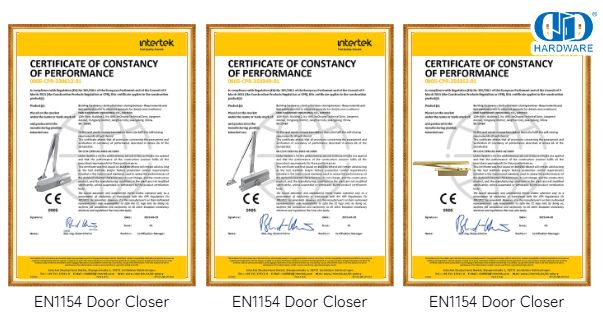
Ratings are just numbers until you apply them to a real-world scenario. You must match the rating to the environment.
Take a supermarket door closer, for instance. This environment presents a unique challenge: high volume traffic combined with air pressure changes from HVAC systems. A standard residential closer would fail within weeks. For a supermarket, you need a Grade 1 closer (for durability) with an adjustable power size (usually Size 4 or 5) to ensure the door latches firmly despite the draft, without snapping shut on customers' heels.
Conversely, for an interior door in an assisted living facility, the priority shifts to accessibility. Here, a Grade 1 closer is still preferred for longevity, but it must be adjusted to a lower power size (Size 1 or 2) to ensure residents can open the door with minimal effort.
Choosing the right door closer is about more than just picking a color that matches the frame. It requires a careful look at traffic volume, door weight, and safety requirements. By paying attention to ANSI grades, EN power sizes, and fire certifications, you ensure your building remains safe, accessible, and code-compliant.
If you are looking for high-quality, certified hardware that meets these rigorous standards, D&D Hardware offers a range of solutions tailored to commercial needs. Whether you need a heavy-duty closer for a main entrance or a concealed unit for a sleek interior design, getting the rating right is the first step toward a secure facility.
Click here for additional details on door closers.
Now contact us.
Contact information for David Jian
Contact number: 0086-139 2903 7292
Email address: sales@danddhardware.com


