
Certified for Safety. Trusted by Leaders Worldwide.
Pls inquire to sales@danddhardware.com
\\: +86 139 2903 7292

 English
 Author: D&D Hardware Publish Time: 2026-02-10 Origin: D&D HARDWARE


The bell rings, and the hallway instantly transforms from a quiet corridor into a chaotic river of students. In this high-energy environment, doors are kicked open, shoved against walls, and often left to slam shut. For facility managers and school administrators, maintaining a safe environment amidst this daily hustle is a top priority.
While we often focus on security cameras and access control systems, one of the most critical components of school safety is purely mechanical. The humble door closer ensures that fire doors latch correctly, noise is contained between classrooms, and small fingers don't get trapped in slamming entryways.
Choosing the right door closer for Educational Institution projects is about more than just closing a door. It is about compliance, longevity, and student safety. Whether you are retrofitting an old university building or designing a new elementary school, understanding the mechanics and standards of these devices is essential.

To understand why specific closers are better suited for schools, we first need to look at how they function. A professional door closer is essentially a spring-like hydraulic device mounted to the head of the door.
When a student pushes the door open, the door body drives a connecting rod. This action rotates a transmission gear, which drives a rack plunger. As this plunger moves, it compresses a powerful internal spring and the hydraulic oil within the chamber.
The magic happens when the student lets go. The accumulated elastic potential energy in the compressed spring releases. It pushes the plunger back, driving the gear and the rod to rotate the door shut. This isn't just a simple spring return, however. The hydraulic oil controls the speed, ensuring the door closes accurately and timely to its initial position without slamming.
A standard residential closer simply cannot handle the abuse found in an educational setting. A door closer for school applications must meet rigorous standards to survive.
In a typical office, a door might open 50 times a day. In a high school, a main entrance or classroom door might open hundreds of times an hour during class changes. This requires heavy-duty construction, often certified to ANSI/BHMA or CE standards, to ensure the mechanism doesn't fail after a few months.
Schools are strictly regulated regarding fire safety. Fire doors must remain closed to prevent the spread of smoke and flames. If a closer fails or is too weak to latch the door against air pressure, the fire barrier is breached. D&D Hardware provides closers that are fire-rated for up to two hours, complying with UL 10C and EN 1634 standards.
Students rarely open doors gently. They often throw them open with force. A feature called "backcheck" is vital here. It acts as a hydraulic buffer that slows the door down before it hits the max opening angle. This prevents the door from smashing into the wall behind it, protecting both the building structure and the hardware itself.


When selecting hardware, you will often see various certifications. It is crucial to choose a device that meets international industry standards.
Certification / Standard | What it Means | Application Context |
|---|---|---|
UL 10C | Positive Pressure Fire Tests of Door Assemblies. | Essential for fire-rated doors in US/American standard schools. |
CE EN 1154 | The European standard for controlled door closing devices. | Required for compliance in European and many international projects. |
ANSI / BHMA | American National Standards Institute performance grading. | Grade 1 is the highest level, recommended for high-traffic school entrances. |
EN 1634 | Fire resistance and smoke control tests. | Ensures the door assembly holds up against heat and flames. |
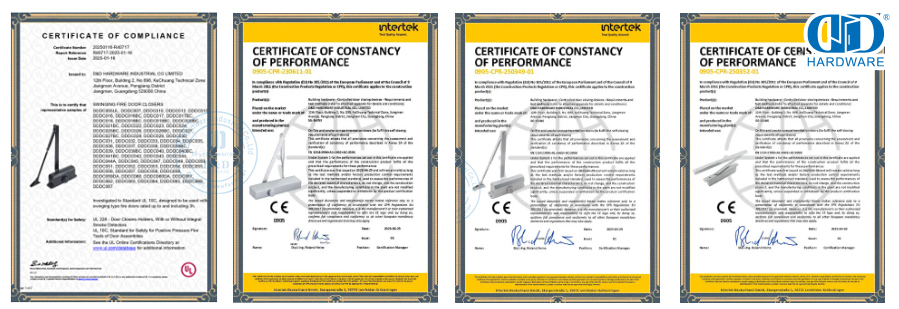
D&D Fire Rated Door Closer :
CE Door Closer - BS EN1154 500,000 cycles test, EN1634 Fire Rated 120/180mins, EN1670 Corrosion Resistance 96 hours.
UL Door Closer - UL Listed, UL 10C Fire Rated 3 Hours, UL File No.R40717
Not every door in a school needs the same type of equipment. D&D Hardware offers various configurations to suit different aesthetic and functional needs.
These are the most common in schools due to their durability and ease of maintenance. They are mounted visibly on the door frame or the door itself.
Best for: Classrooms, stairwells, and utility rooms.
Benefit: Easy to replace or adjust the closing speed without removing the door.
These units are hidden within the door or the frame, offering a clean, tamper-proof look.
Best for: Administrative offices, libraries, or architectural entryways where aesthetics matter.
Benefit: Less prone to vandalism as the body is not exposed.
Installed in the floor, these are heavy-duty closers often used for glass doors or very heavy main entrance doors.
Best for: Main lobby entrances.
Benefit: Can handle extremely heavy doors and offer a very smooth operation.

Even the best door closerwill fail if not installed correctly. In an educational environment, the "closing force" is a delicate balance.
If the spring tension is too high, younger children or students with disabilities may struggle to open the door, which violates accessibility codes (like ADA in the US). If the tension is too low, the door may not latch effectively, compromising security and fire safety.
Most commercial closers from D&D Hardware feature adjustable power sizes and closing speeds. This allows facility managers to fine-tune the door's behavior. For example, a "delayed action" setting can keep the door open for a few extra seconds, giving a class of kindergartners or a student in a wheelchair enough time to pass through safely before the closing cycle begins.
The safety of students and staff relies on the functional integrity of your building's hardware. A broken door closer is not just a nuisance; it is a security risk and a fire safety violation.
Educational institutions require hardware that balances heavy-duty performance with safety and accessibility. By choosing certified, fire-rated closers with features like backcheck and adjustable power, you ensure your facility runs smoothly.
D&D Hardware specializes in manufacturing products that meet strict international standards, including UL and CE certifications, specifically for education, healthcare, and government projects. When you are ready to upgrade your facility's safety and efficiency, reach out to a supplier that understands the unique demands of the educational sector.
Click here for additional details on door closers.
Now contact us.
Contact information for David Jian
Contact number: 0086-139 2903 7292
Email address: sales@danddhardware.com


