
Certified for Safety. Trusted by Leaders Worldwide.
Pls inquire to sales@danddhardware.com
\\: +86 139 2903 7292

 English
 Author: D&D HARDWARE Publish Time: 2026-02-06 Origin: D&D HARDWARE


Public transportation buildings such as metro stations, railway terminals, airports, and bus interchanges are high-risk, high-traffic environments. These facilities operate continuously, serve large and unpredictable passenger flows, and must function reliably during emergency situations. In this context, door hardware is a critical safety and operational system, not a secondary architectural detail.

Public transportation buildings face operational conditions that exceed those of standard commercial projects. Door hardware must withstand:
•Extremely high-frequency operation throughout the day
•Large occupant loads during peak travel periods
•Emergency evacuation scenarios involving mass movement
•Strict fire, life-safety, and accessibility regulations
Any failure in door hardware can lead to service disruption, safety risks, and regulatory non-compliance, making correct selection and configuration a project priority.

Fire protection and emergency evacuation are core design considerations in transportation buildings. Fire-rated doors are installed across concourses, platforms, service corridors, stairwells, and technical rooms. These doors must be equipped with certified fire door hardware systems, including:
•Fire-rated hinges tested to EN1935 or UL 10C
•Certified door locks compliant with EN12209 or UL fire standards
•Fire-rated door closers tested to EN1154 for controlled and reliable closing
•Panic and fire exit hardware tested to EN1125 or UL305
•Door handles and accessories tested for high-cycle public use
All components must work as a fully tested system, ensuring performance under both daily operation and emergency conditions.
Transportation facilities consist of multiple functional zones, each requiring specific door hardware configurations:
•Public circulation areas: heavy-duty hardware with smooth operation and impact resistance
•Emergency exits and stairwells: certified panic hardware ensuring immediate egress
•Staff-only and control rooms: secure locking combined with fire-rated performance
•Service and mechanical rooms: corrosion-resistant hardware for harsh environments
•Platform and concourse fire compartments: complete fire-rated hardware assemblies
This application-based approach allows door manufacturers and contractors to standardize solutions while meeting diverse operational demands.
Public transportation buildings are subject to stringent inspection and approval processes. Door hardware must comply with recognized international standards such as:
•CE certification under EN standards

•UL and ANSI/BHMA certification for UL-regulated markets
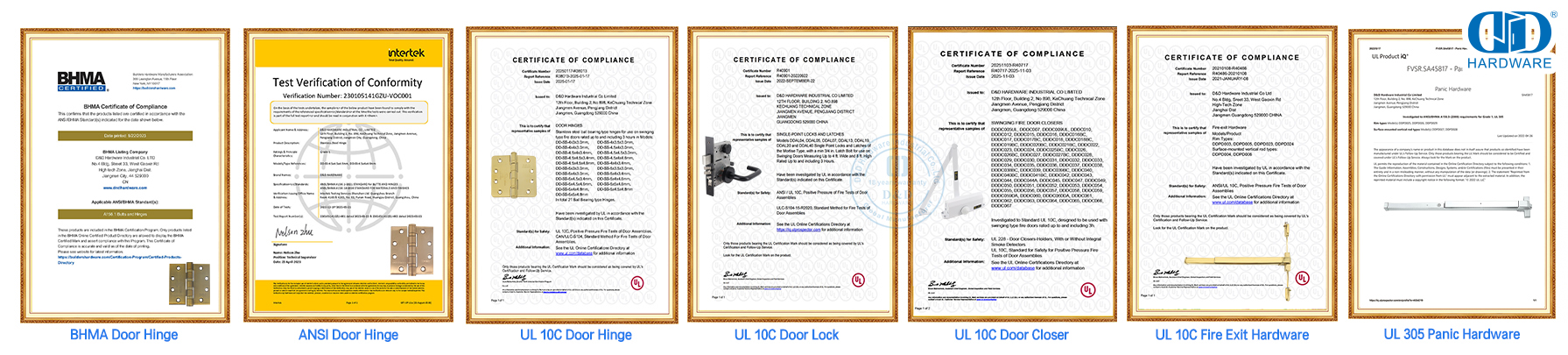
•Local fire, safety, and accessibility regulations
Using certified door hardware simplifies documentation, reduces approval risk, and supports cross-market project execution.
For door factories, hardware brands, and engineering contractors, correctly specified door hardware delivers long-term project value:
•Reduced maintenance and replacement frequency
•Improved system reliability under continuous operation
•Faster project handover and inspection approval
•Lower total lifecycle costs
Offering project-ready door hardware solutions enhances competitiveness in large-scale transportation infrastructure projects.
Door hardware for public transportation buildings must be engineered for extreme usage, strict safety requirements, and long-term reliability. By adopting a system-based, application-driven approach using certified hardware, B2B stakeholders can deliver transportation facilities that are safe, compliant, and operationally resilient.
In public transportation architecture, door hardware is not a supporting component—it is a critical part of the building’s safety and operational infrastructure.
Click here for additional details on fire rated door hardware.
Now contact us.
Contact information for David Jian
Contact number: 0086-139 2903 7292
Email address: sales@danddhardware.com


