
Certified for Safety. Trusted by Leaders Worldwide.
Pls inquire to sales@danddhardware.com
\\: +86 139 2903 7292

 English
 Author: D&D Hardware Publish Time: 2026-02-02 Origin: D&D HARDWARE


Your office is the physical heart of your business operations. It houses your expensive equipment and your proprietary data, and, most importantly, it protects your people. When you lock up for the night, you need absolute certainty that your space is secure. Yet, many business owners treat door hardware as an afterthought, often opting for standard residential locks that simply aren’t built to withstand the demands of a commercial environment.
Choosing the correct office door lock is about balancing security, accessibility, and durability. The wrong choice can lead to frequent replacements, security breaches, or even violations of fire safety codes. Whether you are outfitting a high-traffic corporate headquarters, a small private practice, or a specialized medical facility, understanding the nuances of commercial door hardware is essential.
This guide explores the best options for securing office doors, explains the critical grading systems, and highlights specific requirements for healthcare settings.

The first step in securing your office is acknowledging that a standard lock from a local home improvement store will not suffice. Residential locks are designed for low traffic—perhaps a few entries and exits a day. Commercial locks, however, are engineered to handle hundreds, if not thousands, of cycles daily while resisting physical attacks and vandalism.
Commercial hardware is categorized by the American National Standards Institute (ANSI) and the Builders Hardware Manufacturers Association (BHMA) into three grades. Understanding these grades is vital for making a cost-effective and safe decision.
Grade | Description | Best Application |
|---|---|---|
Grade 1 | Heavy Duty Commercial. The highest level of security and durability. Tested to withstand 1 million cycles and significant physical force. | High-traffic entrances, hospitals, schools, and public buildings. |
Grade 2 | Standard Duty Commercial. Designed for moderate traffic. Tested to 400,000 cycles. | Interior office doors, small businesses, and light commercial use. |
Grade 3 | Residential. Lowest commercial grade. Tested to 200,000 cycles. | Low-traffic interior doors or residential apartments. Not recommended for main office entries. |
For most exterior office doors, a Grade 1 lock is the standard recommendation. For interior offices that see less traffic, a Grade 2 lock is often sufficient and more budget-friendly.
When selecting an office door lock, the mechanism is just as important as the grade. Here are the most common and effective types of locks used in commercial spaces.
Mortise locks are widely considered the gold standard for commercial security. Unlike cylindrical locks that are installed through the door, a mortise lock fits into a pocket (or "mortise") cut into the edge of the door.

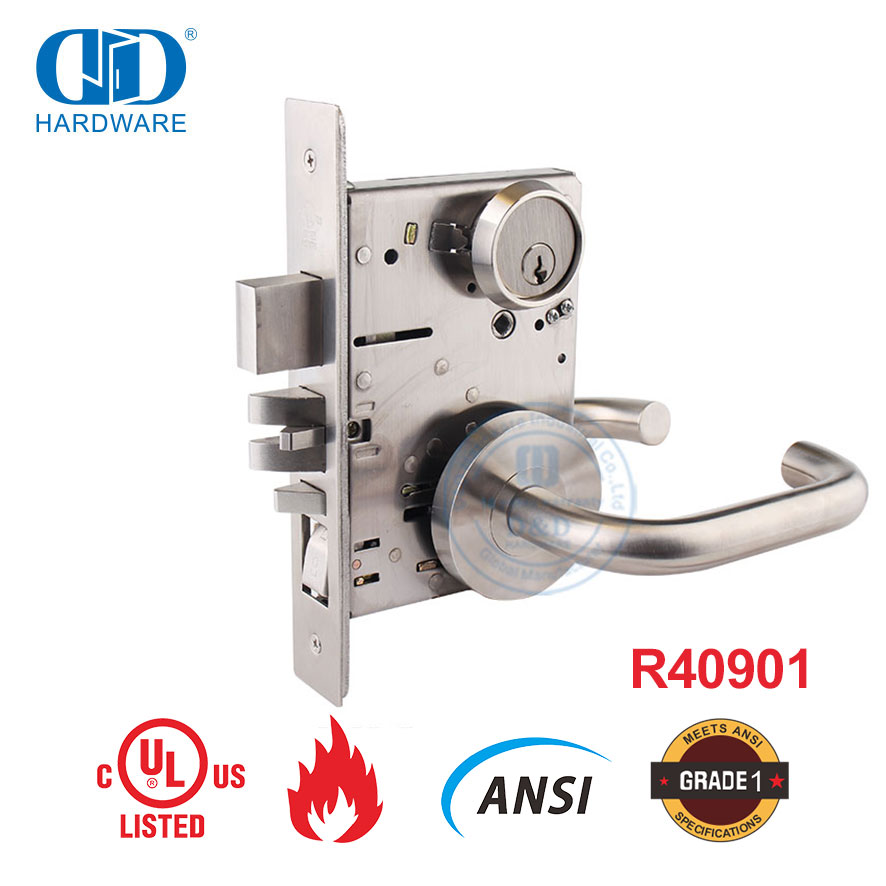
Why choose them?
*Durability: They are incredibly robust and resistant to forced entry.
*Versatility: They offer a wide range of functions (more on that later) and can accommodate various levers and trims.
*Longevity: Because the internal components are housed inside a heavy-duty casing, they tend to last longer than other lock types.
If you are looking for a lock that combines high security with heavy-duty performance, especially for main entrances, the mortise lock is your best bet. At D&D Hardware, our mortise locks comply with EN12209 standards, ensuring top-tier reliability.
Cylindrical locks are the most common type found in office buildings because they are easier to install and replace than mortise locks. The lock body goes through a hole bored into the face of the door, and the latch bolt fits into a hole bored into the edge.


Why choose them?
Cost-effective: Generally cheaper than mortise locks.
Easy Installation: Requires less specialized woodworking to install.
Sufficiency: A Grade 1 cylindrical lock provides excellent security for most standard office doors.
Modern offices are increasingly moving toward electronic access control. These systems use keypads, cards, or biometrics. While the "locking" mechanism is often a mortise or cylindrical device, the access method is digital.


Why choose them?
Audit Trails: You can see who entered a room and when.
Convenience: No need to rekey locks if an employee loses a key or leaves the company; you simply change the code or deactivate the card.
Selecting a door lock for medical institutions or a door lock for hospital environments requires a different approach than a standard corporate office. In these settings, security must coexist with strict hygiene protocols, ease of use for staff carrying supplies, and patient safety.
Hospitals operate 24/7. Patient rooms, supply closets, and operating theaters see constant movement. A Grade 1 lock is non-negotiable in these environments. The hardware must withstand constant use without jamming or failing, as a stuck door in a hospital can be a life-or-death issue.
Healthcare hardware is subjected to rigorous cleaning schedules using harsh chemicals. The finish of the lock must be resistant to corrosion and wear. Stainless steel is often the material of choice for a door lock for hospital use because it is easy to sanitize and resists rust.
In medical institutions, "locking" rarely means trapping people inside. Fire codes are strictly enforced. Panic bars (exit devices) are often required on doors to allow for immediate, hands-free egress in an emergency. D&D Hardware supplies UL-certified panic bars designed specifically for these high-safety requirements.
For X-ray rooms or areas with radiation equipment, doors are often lined with lead. The locks installed on these doors need to be compatible with the weight and thickness of lead-lined doors, requiring specialized heavy-duty hardware.
Not every door needs a key. Installing a keyed lock on a broom closet might be unnecessary, while putting a privacy lock on a conference room is essential. Understanding lock functions will help you purchase the right hardware for each specific door.
Function | Description | Ideal Office Application |
|---|---|---|
Entrance/Keyed Entry | Locked/unlocked by a key from the outside or a turn button from the inside. | Private offices, main entrances, server rooms. |
Privacy | Locked from the inside by a button or thumb turn. Can be unlocked from outside with a coin or tool (for emergencies). | Restrooms, changing rooms, mother’s rooms. |
Passage | Non-locking latch. The handle always retracts the latch. | Hallways, break rooms, closets where security isn't needed. |
Storeroom | Outside lever is always locked (requires a key to enter). Inside lever is always unlocked for free egress. | Supply closets, IT rooms, record archives. |
Classroom | Outside lever is locked/unlocked by a key. Inside lever is always free for immediate exit. Prevents accidental locking from inside. | Meeting rooms, training areas, general offices. |

When you browse product catalogs, you will see various acronyms like UL, CE, and ANSI. These aren't just marketing buzzwords; they are your assurance that the product will perform when it counts.
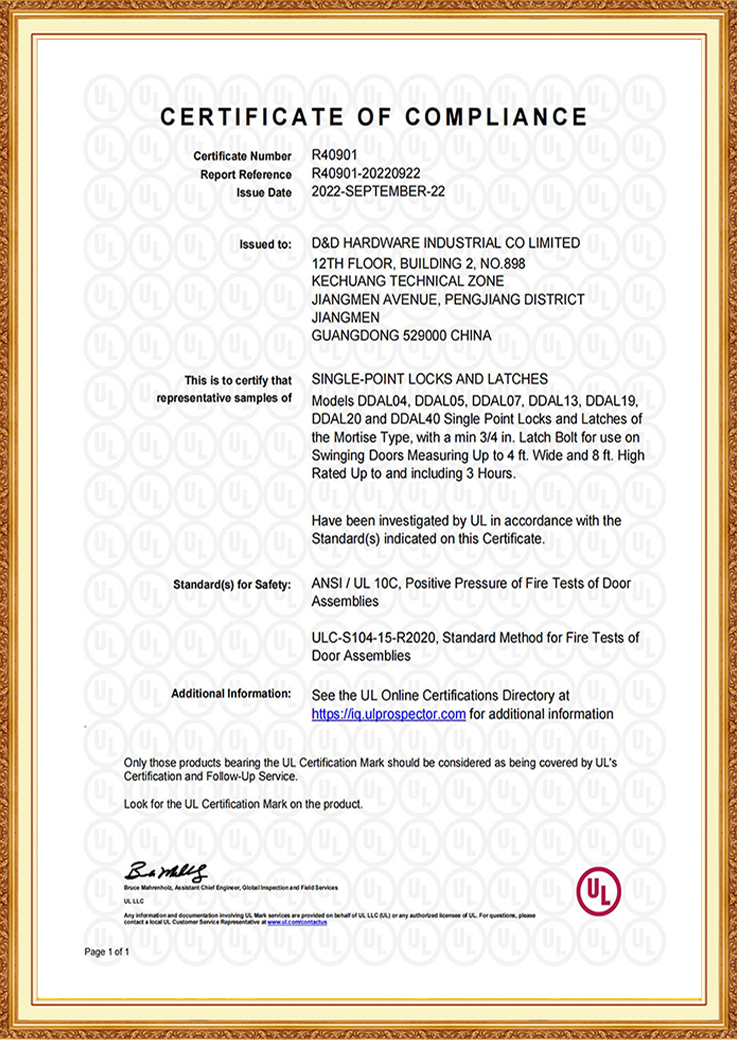
UL (Underwriters Laboratories): This certification is critical for fire doors. If you are installing a lock on a fire-rated door, the hardware must also be fire-rated (e.g., UL 10C) to ensure it keeps the door latched during a fire, preventing the spread of smoke and flames.
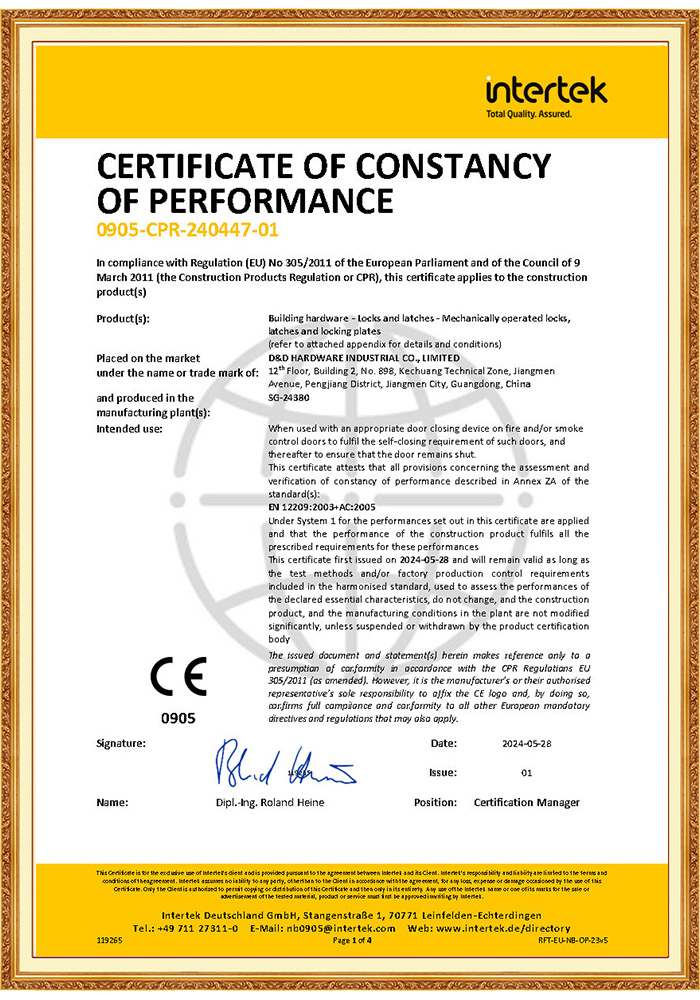
CE Marking: This indicates conformity with health, safety, and environmental protection standards for products sold within the European Economic Area.
ANSI/BHMA: As discussed, this denotes the durability grade of the hardware in the North American market.
At D&D Hardware, our products carry these certifications. We understand that whether you are an architect, a contractor, or a business owner, you need documentation to prove your building is up to code.
The lock you choose for your office door is the first line of defense for your business. While it might be tempting to save money with cheaper, residential-grade hardware, the long-term costs of replacement and the potential security risks make quality hardware the smarter investment.
For standard offices, aim for ANSI Grade 1 or 2 Mortise or Cylindrical locks. For specialized environments like hospitals, prioritize Grade 1 hardware with corrosion-resistant finishes that meet rigorous life-safety codes.
Take the time to assess your specific needs—traffic volume, security level, and function—before making a purchase. The right lock doesn't just close a door; it opens up peace of mind.
With over 17 years of experience in the industry, D&D Hardware provides certified, high-quality door hardware for projects ranging from corporate offices to medical institutions. Whether you need heavy-duty mortise locks or specialized panic bars, we offer factory-direct solutions tailored to your specifications.
Contact us today to discuss your project requirements and find the perfect security solution for your doors.
Click here for additional details on door locks.
Now contact us.
Contact information for David Jian
Contact number: 0086-139 2903 7292
Email address: sales@danddhardware.com


