Certified for Safety. Trusted by Leaders Worldwide.
Pls inquire to sales@danddhardware.com
\\: +86 139 2903 7292

 English
 Author: D&D Hardware Publish Time: 2026-05-08 Origin: D&D HARDWARE


Schools and educational facilities are unique environments where safety, durability, and ease of use must work together seamlessly. Unlike typical commercial buildings, these spaces are used by students, teachers, and staff with varying levels of physical ability and awareness, making door hardware selection more complex.
Doors in schools are opened and closed hundreds—sometimes thousands—of times per day. At the same time, they must perform reliably during emergencies such as fire evacuations or lockdown situations.
This combination creates a clear requirement:
Door hardware must be highly durable for daily use and fail-safe for emergency conditions

A “door hardware set” refers to a pre-defined combination of components designed to work together as a complete system. Instead of selecting items individually, a hardware set typically includes:
•Hinges (load-bearing and alignment)
•Door closers (controlled and automatic closing)
•Locks and latches (security and function)
•Handles or levers (user operation)
•Exit or panic devices (emergency egress)
•Seals (fire, smoke, or acoustic control)
This system-based approach ensures:
•Compatibility between components
•Simplified specification and installation
•Reliable long-term performance

Selecting hardware as individual products often leads to:
•Mismatched performance levels
•Installation complications
•Increased maintenance issues
In contrast, a system-based hardware set ensures that all components:
•Are aligned with the same performance standards
•Function correctly under both normal and emergency conditions
•Support consistent operation across the entire building
For educational facilities, where consistency and safety are essential, this approach significantly reduces risk.
Educational buildings present several distinct challenges that influence hardware selection:
1. High-Frequency Use
Classroom doors, corridors, and common areas experience constant traffic throughout the day.
2. User Behavior
Students may misuse doors—slamming, forcing, or blocking them—requiring hardware that can withstand impact and abuse.
3. Safety Requirements
Doors must support safe evacuation, fire protection, and controlled access when needed.
4. Accessibility
Hardware must be easy to operate for users of all ages and abilities.
5. Maintenance Constraints
Schools require solutions that minimize maintenance disruptions during operational hours.
A key advantage of an application-driven approach is the ability to define hardware sets based on real usage scenarios within educational buildings.
Classroom doors must balance security, accessibility, and daily usability.
Recommended hardware set:
•Fire-rated hinges (EN1935 or UL certified)
•Door closer with smooth and controlled closing
•Classroom function lockset (controlled access from outside, free egress inside)
•Lever handles for ease of use
Key focus:
Safe access control + ease of operation + durability
Corridors are high-traffic zones connecting classrooms and facilities.
Recommended hardware set:
•Heavy-duty hinges for continuous use
•Door closers ensuring consistent closing
•Passage or latch systems depending on function
•Optional acoustic seals for noise control
Key focus:
Durability + smooth operation + noise reduction
Emergency exits are critical for life safety.
Recommended hardware set:
•Fire-rated hinges with high load capacity
•Door closers (EN1154 or UL 10C certified)
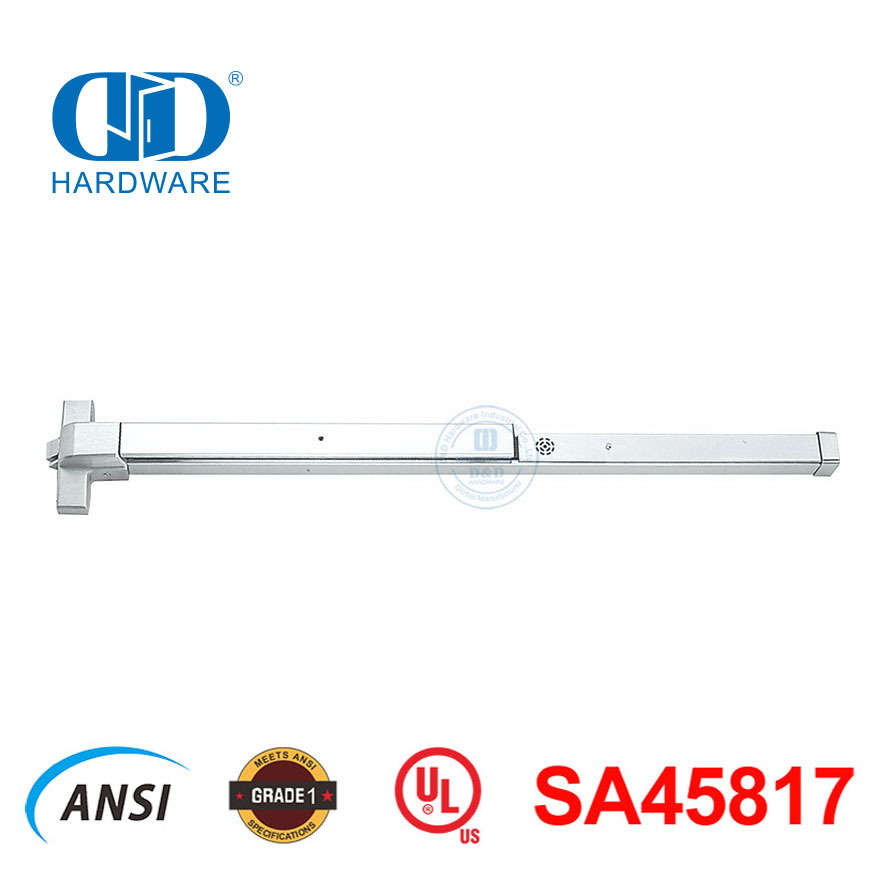
•Panic exit devices (EN1125 or UL305 certified)
•Smoke and fire seals
Key focus:
Immediate egress + reliable fire protection
Large spaces such as gyms and auditoriums require hardware for high occupancy and rapid evacuation.
Recommended hardware set:
•Heavy-duty hinges for oversized doors
•Panic hardware for quick exit
•Door closers with controlled closing force
•Reinforced handles and hardware
Key focus:
High traffic performance + safety under crowd conditions
Office areas within schools require controlled access.
Recommended hardware set:
•Standard hinges (fire-rated where required)
•Door closers for controlled operation
•Locksets with privacy or office functions
•Lever handles
Key focus:
Security + controlled access + consistency
Fire protection is a fundamental requirement in educational buildings.
Fire-rated hardware sets must ensure:
•Doors close automatically after each use
•Doors remain securely latched during fire exposure
•Fire and smoke spread is contained
Typical certifications include:
•EN1935 (butt hinges and concealed hinges)
•EN1154 (door closers, up to 500,000 cycles)
•EN12209 (locks)
•EN1906 (handles)
•EN1303 (cylinders)
•EN1125 (panic exit device)
•EN1634 (fire resistance testing)
•UL 10C (up to 3-hour fire rating)
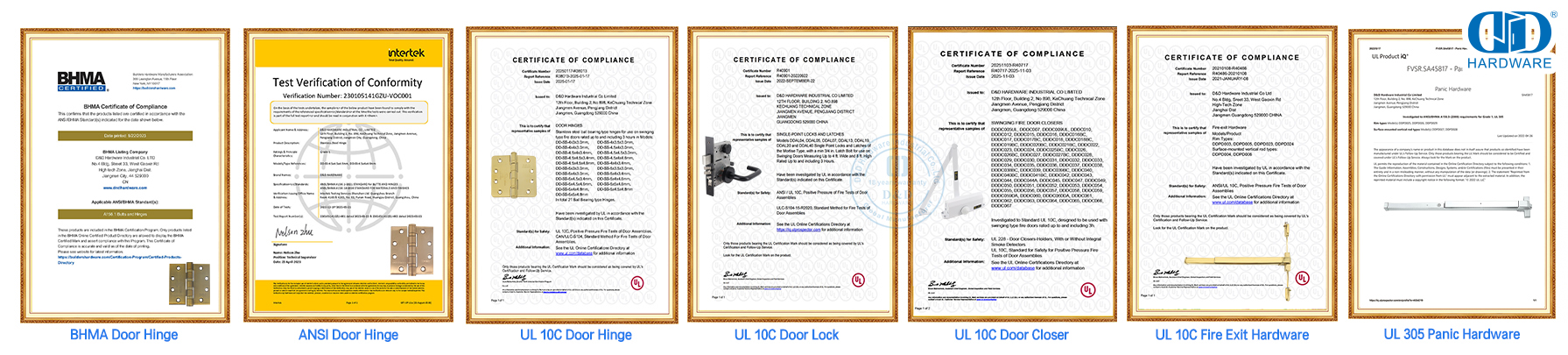

Using certified hardware sets ensures compliance with building regulations and simplifies inspection processes.
In school environments, hardware must withstand:
•Continuous use throughout the day
•Impact from misuse or heavy traffic
•Long-term wear over years of operation
High-quality hardware tested for 200,000–500,000 cycles significantly reduces:
•Maintenance frequency
•Replacement costs
•Operational disruptions
Durability is not just a technical feature—it is a cost-saving factor over the building lifecycle.
Several recurring issues can affect performance and compliance:
•Using residential-grade hardware in high-traffic areas
•Mixing incompatible components within one door system
•Ignoring fire-rated requirements in key zones
•Selecting hardware without considering user behavior
•Poor installation or incorrect adjustment
These mistakes often lead to:
•Safety risks
•Frequent repairs
•Failed inspections

Using pre-defined hardware sets offers several advantages:
•Faster specification and quoting
•Simplified installation processes
•Consistent performance across the building
•Reduced risk of compatibility issues
•Easier maintenance and replacement
For large educational projects, this approach improves both project delivery speed and long-term reliability.
1. Why are door hardware sets preferred over individual components?
Hardware sets ensure that all components are compatible and tested together, reducing installation issues and improving overall performance.
2. What type of hardware is best for high-traffic school doors?
Heavy-duty, certified hardware with high cycle testing (200,000+ cycles) is ideal for handling continuous daily use.
3. Why are panic devices important in educational buildings?
Panic devices allow fast and intuitive exit during emergencies, which is critical in buildings with large numbers of occupants.
4. What is the most critical component in a fire-rated door set?
The door closer is essential because it ensures the door automatically closes, maintaining fire compartment integrity.
5. How can maintenance costs be reduced in schools?
Using durable, certified hardware sets and standardizing configurations across the building can significantly reduce maintenance needs.
6. Why is accessibility important in school door hardware?
Doors must be usable by all individuals, including children and people with limited strength, making lever handles and low opening force essential.
Click here for additional details on fire rated door hardware.
Now contact us.
Contact information for David Jian
Contact number: 0086-139 2903 7292
Email address: sales@danddhardware.com