Certified for Safety. Trusted by Leaders Worldwide.
Pls inquire to sales@danddhardware.com
\\: +86 139 2903 7292

 English
 Author: D&D Hardware Publish Time: 2026-04-25 Origin: D&D Hardware


High-rise buildings represent the pinnacle of modern architectural achievement, housing millions of people in commercial, residential, and mixed-use developments worldwide. However, with increased building height comes heightened fire safety risks that demand rigorous protection measures. Among the most critical components of any high-rise fire safety system is the fire door assembly—and at the heart of every effective fire door lies certified, high-performance fire door hardware.

For project contractors and door manufacturers involved in high-rise construction, selecting the right fire door hardware is not merely a compliance checkbox; it is a life-saving decision that directly impacts occupant safety, project approval timelines, and long-term liability exposure. This comprehensive guide explores the essential fire door hardware applications in high-rise buildings, the certification standards that govern them, and how D&D Technologies' CE and UL certified hardware series deliver the reliability that demanding projects require.
High-rise structures present unique fire safety challenges that low-rise buildings simply do not face:
✔ Extended evacuation times: Occupants on upper floors may require 20–40 minutes to reach ground level safely
✔ Stack effect: Temperature differentials create powerful vertical air currents that accelerate smoke and fire spread through shafts and corridors
✔ Fire department access limitations: External firefighting equipment typically reaches only 50–75 meters, making internal compartmentation the primary defense
✔ Compartmentation dependency: Fire doors serve as the critical barriers that contain fire within its zone of origin, buying precious time for evacuation and emergency response
When a fire door fails due to substandard hardware, the entire compartmentation strategy collapses. Hardware components—hinges, locks, closers, panic devices—must maintain their integrity under extreme heat for the duration specified by local building codes. This is why international certification standards exist and why project specifiers must demand hardware with verified test data.

Hinges bear the full weight of fire doors and must remain functional throughout a fire event. If hinges fail, the door drops, creating gaps that allow smoke and flames to bypass the barrier entirely.
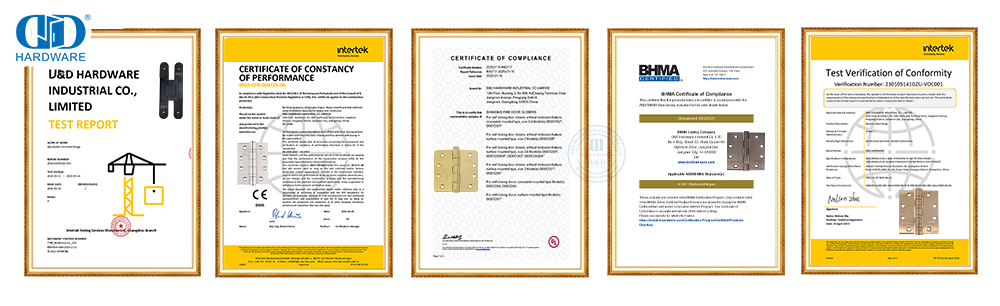
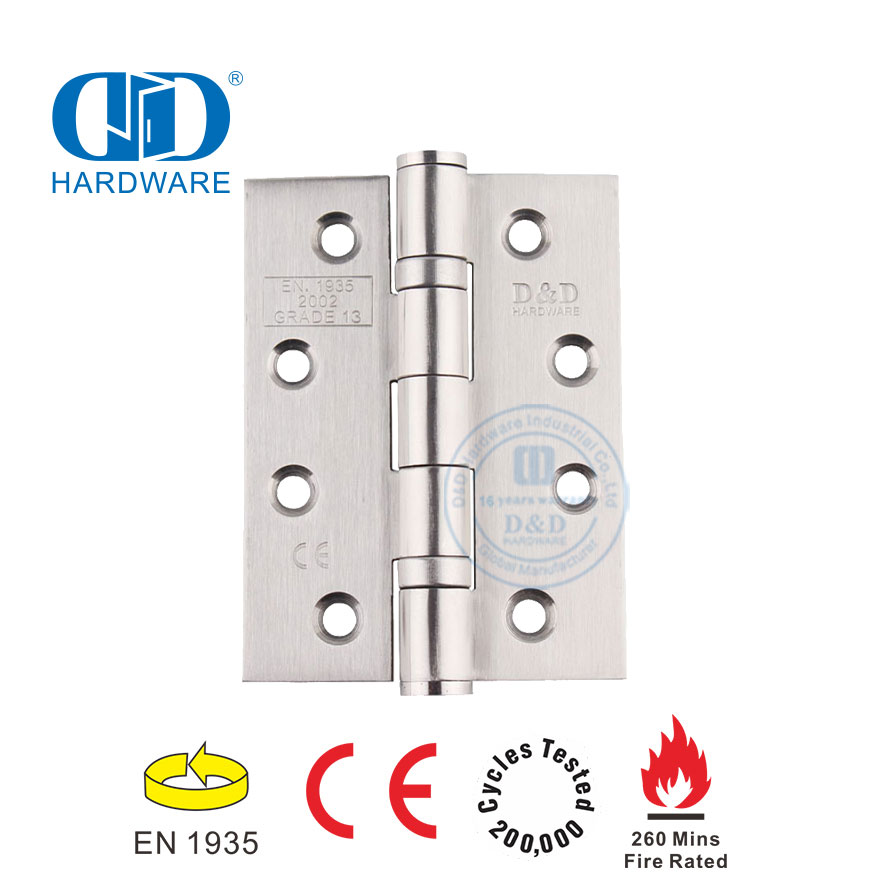
D&D CE Series Door Hinge delivers exceptional performance with BS EN1935 certification for 200,000 cycle durability, EN1634 fire rating of 192 to 260 minutes, and EN1670 corrosion resistance tested to 240 hours. For applications where aesthetics demand hidden hardware, the Concealed Hinge offers BS EN1935 200,000-cycle endurance with 132-minute fire resistance.
For North American projects, the D&D UL Series Door Hinge carries UL/cUL UL 10C certification for 3-hour fire rating (File No. R38013) and meets ANSI/BHMA Grade 1 and Grade 2 standards—ensuring compliance with the strictest US and Canadian building codes.
Fire door locks must secure the door against unauthorized entry while releasing reliably during emergency egress. They must also resist deformation under intense heat that would otherwise allow the door to swing open under pressure differentials.

The D&D CE Series Door Lock achieves BS EN12209 certification with 200,000 cycle testing, EN1634 fire ratings of 111 to 260 minutes, and 240-hour corrosion resistance. The companion Lock Cylinder carries BS EN1303 certification for 100,000 cycles, 183-minute fire resistance, and 96-hour corrosion protection.
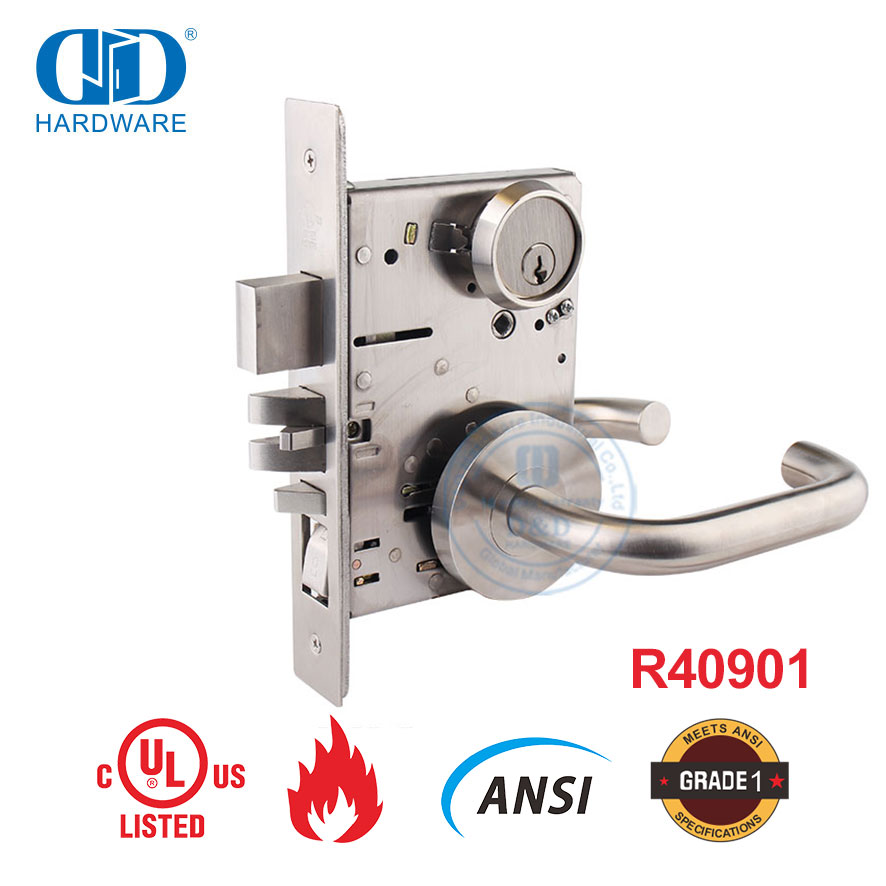
In the UL Series, the Door Lock achieves UL 10C 3-hour fire rating (File No. R40901), providing project contractors with a single-source solution for both European and North American compliance requirements.
A fire door that remains open is functionally useless. Door closers ensure that fire doors return to their closed and latched position after every use—a requirement that becomes even more critical in high-traffic commercial towers where doors may cycle hundreds of times daily.
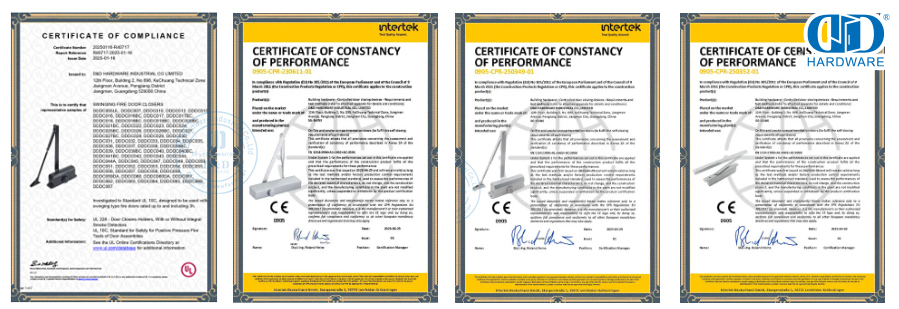
The D&D CE Series Door Closer exceeds expectations with BS EN1154 certification for an industry-leading 500,000 cycles, EN1634 fire ratings of 120 to 180 minutes, and 96-hour corrosion resistance.
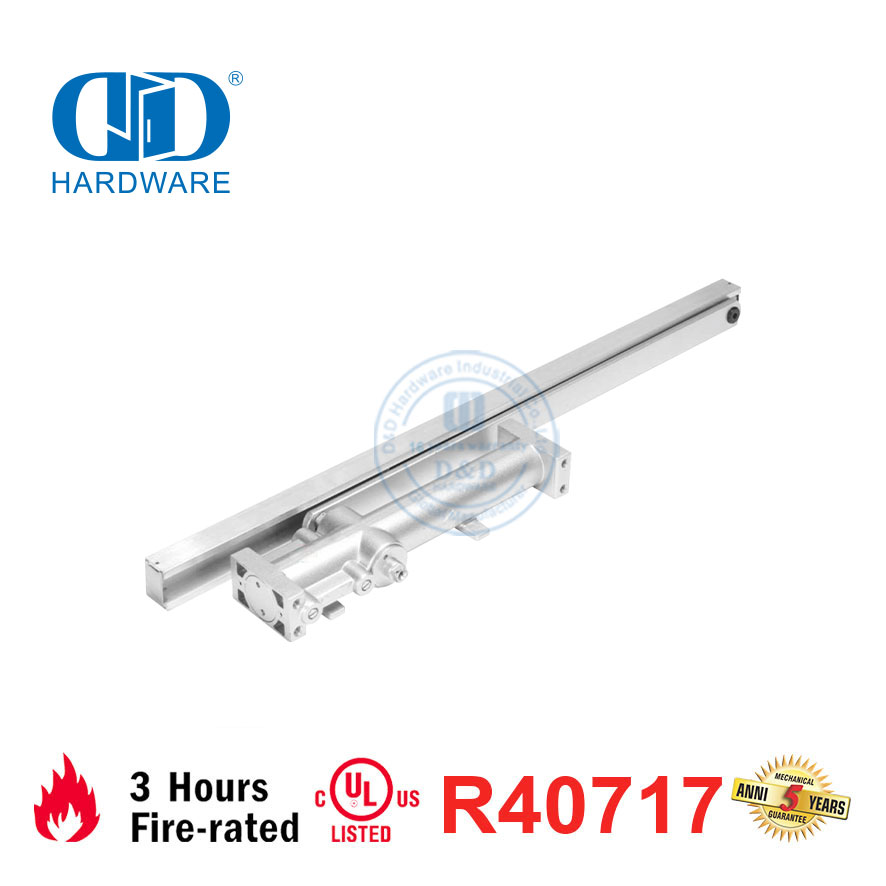
The UL Series Door Closer matches this reliability with UL 10C 3-hour fire rating (File No. R40717), ensuring consistent performance across both certification regimes.
Door handles are the most frequently contacted hardware component and must maintain structural integrity under fire conditions while providing ergonomic operation for all building occupants, including those with limited mobility.

The D&D CE Series Door Handle achieves BS EN1906 certification for 300,000 cycles—the highest cycle rating in the series—combined with EN1634 fire resistance of 183 to 260 minutes and 240-hour corrosion protection, making it ideal for high-traffic corridors in commercial and residential towers.
In high-rise buildings, stairwell doors and emergency exit routes must allow rapid, intuitive egress without specialized knowledge. Panic and fire exit hardware enables occupants to push a single bar and exit immediately—a requirement codified in virtually every international building standard.
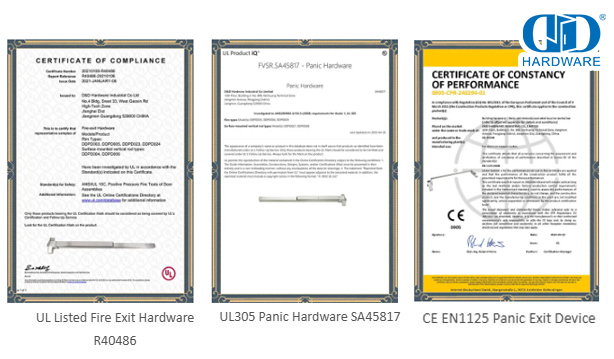
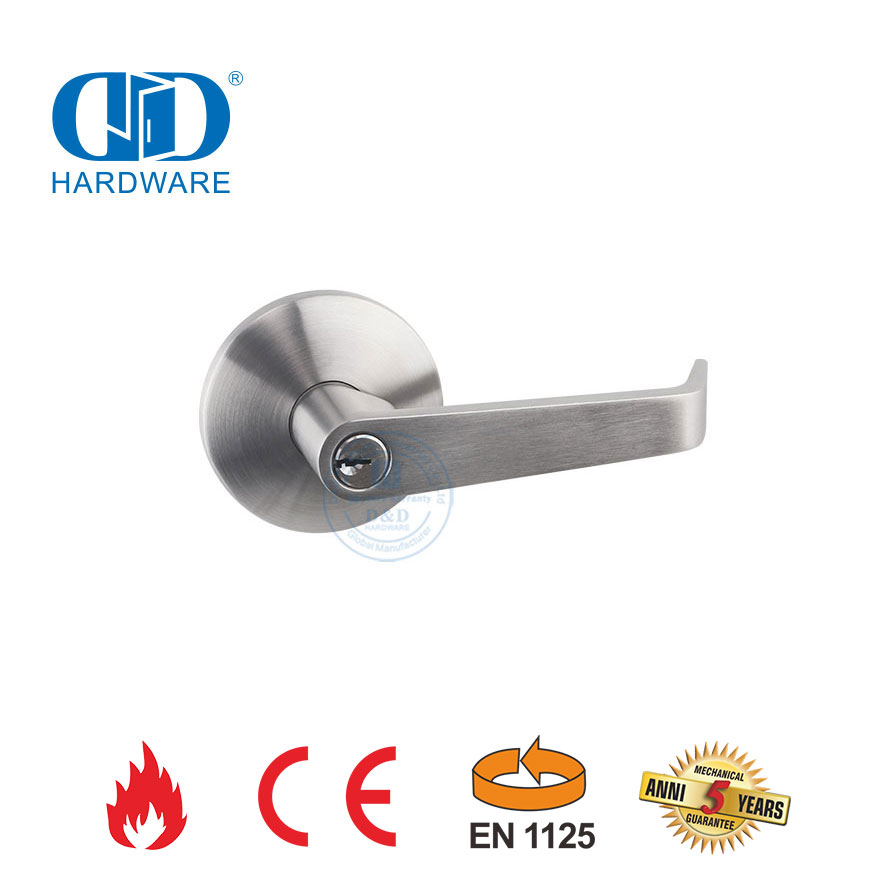
The D&D CE Series Panic Exit Device carries BS EN1125 certification for 200,000 cycles, EN1634 fire ratings of 132 to 240 minutes, and 240-hour corrosion resistance.
For projects requiring UL certification, the Fire Exit Hardware achieves UL 10C 3-hour fire rating (File No. R40486), while the Panic Hardware carries UL305 certification (File No. SA45817), covering both fire-rated and non-fire-rated egress applications.
Understanding certification frameworks is essential for specifiers working on international projects:
▪EN1634: Fire resistance testing for door assemblies—measures integrity (E) and insulation (I) under standardized furnace conditions
▪EN1935 / EN12209 / EN1154 / EN1906 / EN1303 / EN1125: Product-specific standards covering hinges, locks, closers, handles, cylinders, and panic devices respectively
▪EN1670: Corrosion resistance classification—critical for coastal high-rises and buildings in humid climates
▪UL 10C: Positive pressure fire test for door assemblies—the current standard replacing the older UL 10B
▪ANSI/BHMA Grades: Grade 1 represents the highest commercial duty rating, Grade 2 for heavy commercial use
▪UL 305: Standard for panic hardware—ensuring reliable operation under emergency conditions
D&D Technologies's dual certification portfolio (CE and UL series) enables project contractors and door factories to source a single hardware ecosystem that satisfies both European and North American code requirements—simplifying procurement, reducing compliance risk, and accelerating project delivery.

When specifying fire door hardware for high-rise applications, project contractors and door manufacturers should evaluate the following criteria:
1.Fire Rating Alignment:
Match hardware fire ratings to the door assembly rating specified by the fire engineer. A 2-hour fire door requires hardware rated for at least 120 minutes—D&D CE Series hardware offers ratings up to 260 minutes, providing substantial safety margins.
2.Cycle Durability:
High-rise commercial buildings experience heavy foot traffic. Hardware rated for 200,000 to 500,000 cycles ensures longevity and reduces maintenance costs over the building lifecycle.
3.Corrosion Resistance:
Coastal developments and buildings in tropical climates demand hardware with proven corrosion resistance. D&D CE Series components achieve up to 240 hours under EN1670 salt spray testing.
4.Certification Documentation:
Always request and verify test reports, certification files, and declaration of performance documents. D&D UL Series products carry verifiable file numbers (R38013, R40901, R40717, R40486, SA45817) that can be cross-referenced with UL databases.
5.Complete System Compatibility:
Sourcing all hardware components from a single manufacturer ensures dimensional compatibility, consistent finish options, and unified warranty coverage—eliminating the integration risks that arise from mixing brands.
Consider a 60-story mixed-use development with retail podium levels, Grade A office floors, and luxury residential apartments above. The fire strategy typically divides the tower into multiple refuge zones, each requiring fire-rated stairwell doors, corridor doors, and apartment entrance doors.
For stairwell doors serving as primary evacuation routes, specifiers would select:
•UL Series Fire Exit Hardware (UL 10C, 3-hour rating) for intuitive egress
•UL Series Door Closer (UL 10C, 3-hour rating) for reliable self-closing
•UL Series Door Hinge (UL 10C, 3-hour rating, ANSI/BHMA Grade 1) for heavy-duty performance
For residential apartment entrance doors:
•CE Series Door Lock (EN1634, 260-minute rating) for security and fire protection
•CE Series Door Handle (EN1906, 300,000 cycles) for daily durability
•CE Series Concealed Hinge (EN1634, 132-minute rating) where aesthetic requirements demand hidden hardware
This systematic approach ensures every door assembly meets its designated fire rating while maintaining the operational reliability that building occupants expect.

Fire door hardware is the unsung hero of high-rise building safety. While architectural finishes and structural systems receive the most attention during design, it is the hinges, locks, closers, and panic devices that ultimately determine whether a fire door performs as intended when lives depend on it.
For project contractors and door factories, partnering with a hardware manufacturer that offers comprehensive certification coverage, proven cycle durability, and corrosion resistance is not a procurement detail—it is a risk management imperative. D&D Technologies's CE and UL certified hardware series provide the verified performance data, international code compliance, and complete system compatibility that demanding high-rise projects require.
When specifying fire door hardware for your next high-rise development, demand certified performance, verify test documentation, and choose a supplier that stands behind every component with transparent, auditable certification records. The safety of thousands of future building occupants depends on the decisions you make today.
For detailed product specifications, certification documents, and project consultation, contact D&D Technologies's architectural hardware specialists. We support project contractors and door manufacturers from specification through delivery with certified fire door hardware solutions for high-rise applications worldwide.
Click here for additional details on fire rated door hardware.
Now contact us.
Contact information for David Jian
Contact number: 0086-139 2903 7292
Email address: sales@danddhardware.com