
Certified for Safety. Trusted by Leaders Worldwide.
Pls inquire to sales@danddhardware.com
\\: +86 139 2903 7292

 English
 Author: D&D Hardware Publish Time: 2026-04-14 Origin: D&D HARDWARE


In modern commercial construction, life safety and regulatory compliance are fundamental considerations. Among the many components that contribute to a building’s passive fire protection system, fire rated door closers play a pivotal role. While often overlooked, these devices ensure that fire doors perform as intended during an emergency by automatically returning doors to a closed position, thereby preventing the spread of fire and smoke.

For door manufacturers, hardware distributors, architects, and engineering contractors, selecting the right fire rated door closer is essential for meeting project specifications, passing inspections, and ensuring long-term operational reliability. This article provides a comprehensive guide to the application, certification, and configuration of fire rated door closers in various commercial building scenarios, aligning with the positioning of a Building Project Application Site.
Fire doors are designed to compartmentalize buildings, limiting the spread of flames and smoke and providing occupants with safe evacuation routes. However, a fire door can only function effectively if it remains closed during a fire event. This is where fire rated door closers become indispensable.
o Ensures that fire doors return to the closed and latched position after each use.
o Maintains the integrity of fire compartments.
o Prevents the rapid spread of smoke and flames through corridors and stairwells.
o Regulates opening and closing speeds to enhance safety and accessibility.
o Ensures that escape routes remain protected and functional during emergencies.
Without a properly specified and installed fire rated door closer, even a certified fire door assembly may fail to meet safety standards.

Certification is a critical factor in the selection of fire rated door closers, particularly for international projects. Compliance with recognized standards not only ensures safety but also simplifies approval by local authorities.
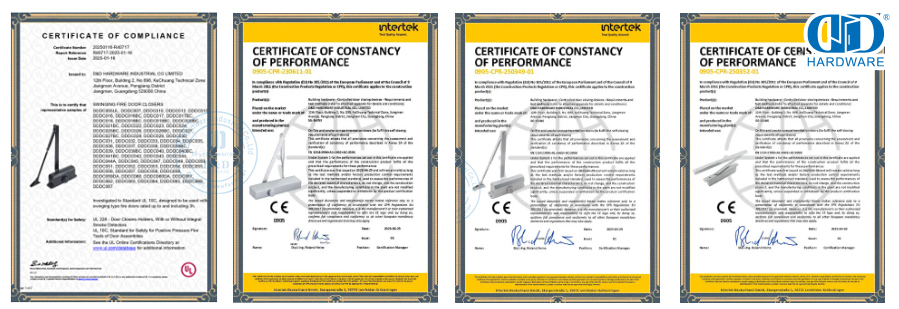
BS EN1154 – Controlled Door Closing Devices
· Cycle Testing:500,000 cycles, ensuring durability in high-traffic environments.
· Performance Classification: Confirms reliability and operational efficiency.
· Adjustability: Allows customization of closing speed and latching action.
EN1634 – Fire Resistance
· Provides fire resistance ratings of 120 minutes and 180 minutes, ensuring compatibility with various fire door assemblies.
EN1670 – Corrosion Resistance
· Tested for 96 hours, making the door closer suitable for humid or semi-exposed environments such as transportation hubs and coastal buildings.
Key Advantages of CE-Certified Door Closers
· Compliance with European and international building regulations.
· High durability for commercial applications.
· Suitable for a wide range of architectural environments.


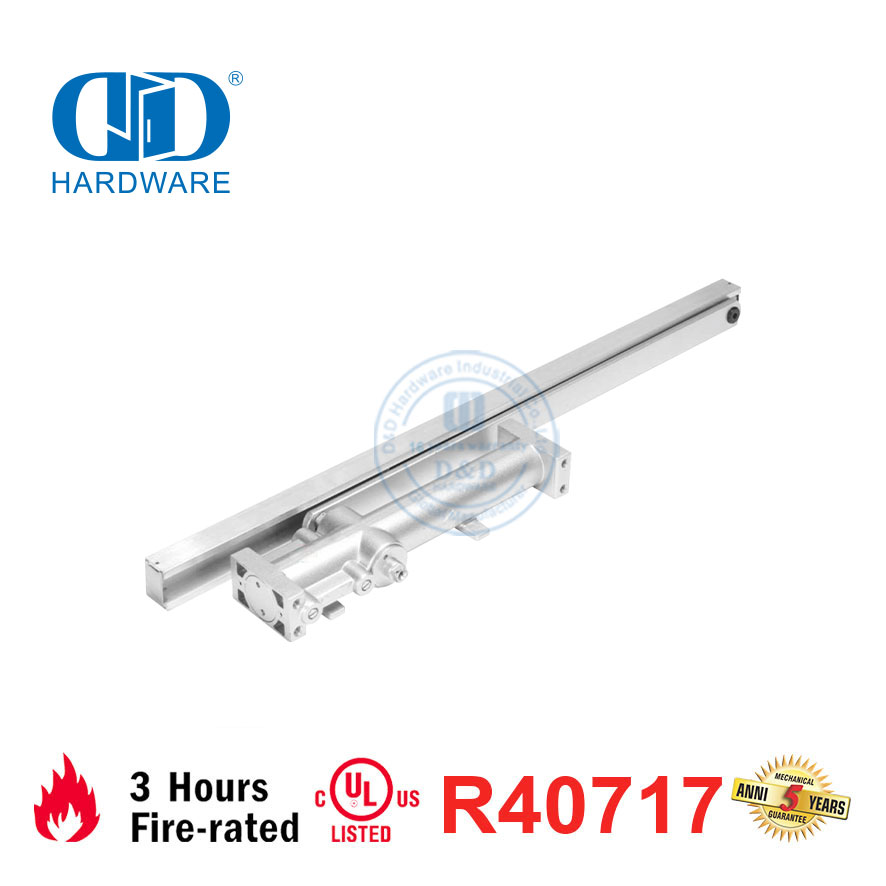
UL 10C – Positive Pressure Fire Tests of Door Assemblies
· Fire resistance rating of up to 3 hours.
· Ensures reliable performance under real fire conditions.
· Recognized across North America and many international markets.
File Number:R40717
Benefits of UL-Certified Door Closers
· Facilitates compliance with NFPA 80, NFPA 101, and IBC requirements.
· Enhances acceptance in government and institutional projects.
· Provides assurance of performance in high-risk environments.


Commercial buildings such as airports, hospitals, and shopping malls experience high-frequency door usage. Door closers tested to 500,000 cycles ensure long-term reliability and reduced maintenance costs.
Adjustable valves allow precise control over:
· Closing speed
· Latching speed
· Backcheck (resistance to sudden opening)
· Delayed action (useful for accessibility and service operations)
These features enhance both safety and user convenience.
Fire rated door closers must be compatible with:
· Fire-rated door leaves and frames
· Certified hinges and locks
· Intumescent and smoke seals
System compatibility ensures that the entire door assembly performs effectively during a fire.
With EN1670 corrosion resistance (96 hours), these door closers are suitable for:
· Coastal hotels and resorts
· Transportation terminals
· Industrial and service areas
· Semi-exterior applications
Different mounting configurations allow adaptation to diverse architectural requirements:
· Regular Arm Mount: Standard and cost-effective.
· Top Jamb Mount: Ideal for outward-opening doors.
· Parallel Arm Mount: Offers better vandal resistance and aesthetic appeal.
· Concealed Mount: Preferred in high-end commercial interiors.

In office environments, fire rated door closers are essential for:
· Stairwell doors to maintain protected escape routes.
· Corridor fire doors to ensure compartmentalization.
· Service rooms such as electrical and IT spaces.
Key Requirements:
· Quiet and smooth operation.
· Compliance with accessibility standards.
· Long-term reliability.
Hotels require door closers that combine safety, comfort, and aesthetics.
Applications:
· Guest room corridor doors.
· Stairwell and fire lobby doors.
· Back-of-house service areas.
Benefits:
· Noise reduction through controlled closing.
· Concealed options for design integration.
· Reliable performance with minimal maintenance.
Retail environments demand heavy-duty door closers capable of withstanding constant use.
Typical Locations:
· Main egress routes.
· Tenant fire-rated partitions.
· Loading docks and service corridors.
Considerations:
· Parallel arm mounting to reduce vandalism.
· Integration with panic exit devices.
· High durability for peak traffic periods.
Hospitals and medical centers require door closers that support infection control and accessibility.
Key Features:
· Delayed action for wheelchair and bed movement.
· Smooth operation to minimize noise.
· Compatibility with smoke control systems.
Airports, railway stations, and metro terminals present extreme operational demands.
Requirements:
· High-cycle durability.
· Corrosion resistance in semi-exposed environments.
· Reliable performance during mass evacuations.
Building Area | Recommended Door Closer Features |
Stairwells | Heavy-duty, fire-rated, adjustable backcheck |
Corridors | Smooth closing, accessibility compliance |
Service Rooms | Durable and corrosion-resistant |
Main Entrances | Parallel arm mounting for vandal resistance |
Exterior Exits | Weather-resistant and high-strength construction |
High-End Interiors | Concealed door closers for aesthetics |
This application-based configuration enables door manufacturers and contractors to standardize specifications while addressing diverse project requirements.
Fire rated door closers must align with major international regulations, including:
· NFPA 80: Installation and maintenance of fire doors.
· NFPA 101 (Life Safety Code): Requirements for means of egress.
· International Building Code (IBC): Fire safety provisions.
· European Construction Products Regulation (CPR): CE marking requirements.
Using certified door closers with EN1154, EN1634, EN1670, and UL 10C approvals simplifies project documentation and inspection processes.
Despite the availability of certified products, several issues can compromise fire door performance:
o Using a closer with a lower fire rating than the door assembly.
o Incorrect mounting positions or missing fasteners.
o Propping doors open or removing the closer for convenience.
o Excessive closing speed leading to slamming or incomplete latching.
o Substituting components not included in the tested assembly.
Avoiding these pitfalls is essential for ensuring code compliance and occupant safety.

· Simplified integration into fire-rated door assemblies.
· Enhanced product value through certified hardware solutions.
· Improved acceptance in international markets.
· Ability to offer complete system solutions.
· Increased competitiveness in large-scale commercial projects.
· Confidence in meeting regulatory requirements.
· Flexibility in design through various mounting options.
· Reduced risk of inspection failures.
· Lower lifecycle maintenance costs.
· Faster project handover.
To ensure optimal performance in commercial projects, consider the following best practices:
o Choose door closers compliant with BS EN1154, EN1634, EN1670, and UL 10C standards.
o Verify that all hardware components are tested as part of a fire door assembly.
o Essential for high-traffic commercial environments.
o Use corrosion-resistant finishes for humid or coastal locations.
o Validate performance before large-scale installation.
o Periodic inspections ensure long-term reliability and compliance.
Fire rated door closers are a critical component of passive fire protection systems in commercial buildings. Their ability to ensure automatic door closure, maintain fire compartment integrity, and support safe evacuation makes them indispensable in modern construction.
With certifications such as BS EN1154 (500,000 cycles), EN1634 fire ratings of 120/180 minutes, EN1670 corrosion resistance, and UL 10C fire ratings of up to 3 hours (File No. R40717), these door closers provide the reliability and compliance required for international commercial projects.
For door manufacturers, hardware suppliers, architects, and contractors, adopting a system-based, application-driven approach to door closer selection not only enhances safety but also improves project efficiency and long-term building performance.
In the context of commercial construction, fire rated door closers are not merely accessories—they are essential life safety devices that safeguard occupants, protect assets, and ensure regulatory compliance. By specifying certified, heavy-duty mechanical solutions, stakeholders can confidently deliver projects that meet the highest standards of safety and durability.
Click here for additional details on door closers.
Now contact us.
Contact information for David Jian
Contact number: 0086-139 2903 7292
Email address: sales@danddhardware.com


