
Certified for Safety. Trusted by Leaders Worldwide.
Pls inquire to sales@danddhardware.com
\\: +86 139 2903 7292

 English
 Author: D&D Hardware Publish Time: 2025-12-02 Origin: D&D HARDWARE


Updating your cabinetry with European-style hardware is one of the most impactful upgrades you can make to a kitchen or bathroom. The sleek, invisible look of concealed hinges modernizes a space instantly, removing the visual clutter of exposed knuckles and screws. However, unlike traditional surface-mounted hardware, you can’t just eyeball the placement.
Drilling a large 35mm cup hole into your cabinet door is a commitment. If you drill in the wrong spot, you can’t simply fill the hole and try again without leaving a visible scar on the inside of your cabinetry. The difference between a professional-looking installation and a crooked door often comes down to knowing exactly where to mark your center points.
Whether you are building new doors from scratch or retrofitting old cabinets, understanding the geometry of hinge placement is essential. This guide will walk you through the standard measurements, how to handle heavy or tall doors, and the specific formulas used to ensure your concealed hinges function perfectly for years to come.
When determining where on the door to place concealed hinges, start with the vertical positioning. While there is no single international law governing this measurement, there is a widely accepted industry standard that balances stability with aesthetics.
For most standard cabinet doors, the center of the hinge cup should be positioned between 3 inches (76mm) and 4 inches (100mm) from the top and bottom edges of the door.
This range provides excellent stability. Placing the hinges too close to the corners can weaken the structural integrity of the wood, especially if the door is made of particleboard or MDF. Conversely, placing them too close to the center of the door allows the corners to flex and warp over time, preventing the door from closing flush against the cabinet frame.
If you are working with shaker-style or raised-panel doors, you need to pay attention to the construction. These doors are built with "stiles" (the vertical side pieces) and "rails" (the horizontal top and bottom pieces).
You should avoid drilling the hinge cup hole exactly where the rail and stile meet. Drilling into the joinery (the biscuits, dowels, or tenons holding the door together) can compromise the strength of the door.
The Fix: Inspect the back of the door to see where the joint line is. Adjust your 3-to-4-inch measurement up or down slightly so the hinge cup sits entirely within the solid wood of the stile, clearing the joint by at least half an inch.

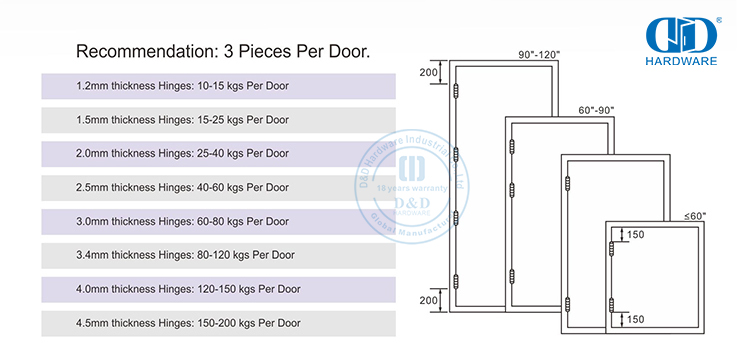
The "two hinges per door" rule works well for standard wall cabinets or base cabinets up to about 40 inches in height. However, as doors get taller and heavier, gravity begins to work against you. A pantry door or a tall utility closet door requires more support to prevent sagging and warping.
Here is a general guide for vertical placement based on door height:
Total Hinges: 2
Placement: 3-4 inches from the top and bottom.
Total Hinges: 3
Placement: Keep the top and bottom hinges at the standard 3-4 inch distance. Place the third hinge exactly in the center of the two outer hinges. This middle hinge is crucial for keeping the door straight and preventing the middle section from bowing outward.
Total Hinges: 4
Placement: Place top and bottom hinges as usual. Space the remaining two hinges evenly between the top and bottom.
Total Hinges: 5
Placement: Top and bottom as usual. Space the remaining three hinges evenly.
Pro Tip: If you have shelves inside the cabinet, check their location before drilling your middle hinges. You don’t want to install a hinge exactly where a shelf sits, as the hinge arm or mounting plate might hit the shelf edge, preventing the door from closing. Always measure the cabinet interior first and transfer those "no-go" zones to your door.
Once you have your vertical positions marked (e.g., 3.5 inches from the top and bottom), you need to determine the horizontal position. This is arguably the most critical measurement for concealed hinges.
This measurement is known as the bore distance (or tab distance). It is the distance from the edge of the door to the edge of the cup hole (not the center of the hole).
For most standard concealed hinges, the bore distance is between 3mm and 6mm (1/8 inch to 1/4 inch).
3mm to 5mm is the sweet spot for most overlay hinges.
If you drill too close to the edge (less than 3mm), the thin strip of wood remaining may crack under the stress of opening the door.
If you drill too far from the edge (more than 6mm), the door might bind against the cabinet frame when you try to open it, or the adjustment screws won't have enough range to align the door properly.
Important: Always check the specification sheet that came with your specific hinges. Different manufacturers (Blum, Salice, Grass) have specific bore distance requirements to achieve the correct overlay. If you threw away the instructions, a 5mm bore distance is usually a safe bet for standard 35mm cup hinges.
D&D CE Concealed Hinge-BS EN1935 200,000 cycles test, EN1634 Fire Rated 132mins, EN1670 Corrosion Resistance 48 hours.

Now that you understand the logic behind the placement, here is the practical workflow for getting it right.
Decide on your top and bottom spacing (e.g., 3.5 inches). Hook your tape measure on the top edge of the door and mark a line across the stile at 3.5 inches. Do the same from the bottom edge.
You need to find the center point for your drill bit.
If you are using a 35mm hinge cup and a 5mm bore distance:
Radius of cup: 17.5mm
Bore distance: 5mm
Center point: 22.5mm from the edge.
Mark this intersection on your vertical line. This is where the tip of your Forstner bit will go.
While you can measure manually, using a plastic drilling template or a hinge jig is highly recommended. These inexpensive tools usually have V-notches that align with your center line and guide your drill bit to the exact distance from the edge required. This eliminates the math and reduces the risk of "drill walking."
Using a 35mm Forstner bit, drill into the door at your marked center point. Most concealed hinges require a hole depth of 1/2 inch (12mm to 13mm). Be extremely careful not to drill all the way through the door face. Use a drill press with a stop, or wrap a piece of masking tape around your drill bit to indicate when to stop.
Insert the hinge cup into the hole. Before screwing it down, you must ensure the hinge arm is perfectly perpendicular to the door edge. If the hinge is twisted, the door will bind. Use a square or a long straight edge (like a ruler) pressed against the flat side of the hinge arm to ensure it is square with the door edge.

You can install them on almost any solid wood or MDF door, provided the door is thick enough. Most concealed hinges require a door thickness of at least 1/2 inch to 5/8 inch (14mm-16mm) to accommodate the cup depth without bursting through the front.
Yes. While height usually dictates hinge count, weight is a major factor. If you have a short door that holds a heavy spice rack or a trash can pull-out, adding a third hinge provides extra load-bearing capacity and prevents the screws from stripping out over time.
If you drilled slightly off-center, you can usually fix it by plugging the hole with a wood dowel glued in place, waiting for it to dry, and re-drilling. If the hole is wildly out of place, you may need to use a hinge repair plate or fill the hole with a two-part wood filler (like Bondo) before re-drilling.
Installing concealed hinges is less about carpentry magic and more about following a specific recipe. By adhering to the 3-to-4-inch rule for vertical placement and verifying the specific bore distance for your hardware, you ensure your cabinets will operate smoothly.
Remember, the goal is consistency. If you are doing a whole kitchen, create a "story stick" (a piece of scrap wood marked with your hinge locations) to transfer the exact same measurements to every single door. This ensures that even if your measurements are a millimeter off, they are uniformly off, keeping your kitchen looking symmetrical and professionally finished.
Click here for additional details on concealed door hinges.
Now contact us.
Contact information for David Jian
Contact number: 0086-139 2903 7292
Email address: sales@danddhardware.com


