
Certified for Safety. Trusted by Leaders Worldwide.
Pls inquire to sales@danddhardware.com
\\: +86 139 2903 7292

 English
 Author: D&D Hardware Publish Time: 2026-05-12 Origin: D&D HARDWARE


In public buildings, safe evacuation is not just a design consideration—it is a core life safety requirement. During emergencies such as fires, smoke incidents, or crowd movement situations, exit doors must allow occupants to leave the building quickly, intuitively, and without obstruction.
This is where panic bars play a critical role.

•Immediate door release under pressure
•Fast evacuation in high-occupancy areas
•Reliable operation during emergencies
•Compliance with international fire and egress standards
•Shopping malls
•Schools and universities
•Hospitals
•Airports and transportation terminals
•Hotels
•Stadiums and public assembly buildings
•Commercial office buildings
In these environments, panic bars are not simply door accessories—they are part of the building’s life safety system.

Many people assume that any exit device can function as panic hardware. In reality, certified panic bars are engineered for a completely different purpose.
A standard lock focuses primarily on security.
•Fast egress
•Safe evacuation
•Fire door compatibility
•Reliable operation under crowd pressure
This distinction is critical in high-occupancy buildings where evacuation speed directly affects occupant safety.
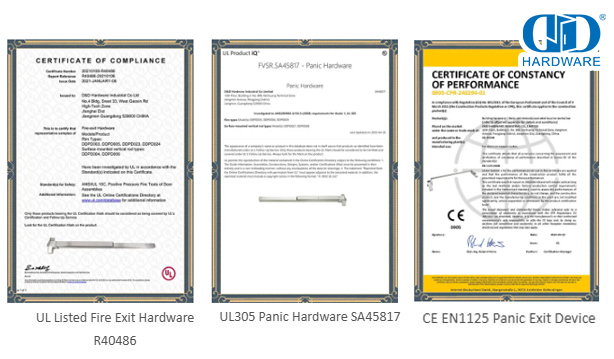
CE Certified Panic Exit Device
•BS EN1125 certified
•200,000 cycles durability test
•EN1634 fire-rated up to 132/240 minutes
•EN1670 corrosion resistance up to 240 hours
UL Certified Fire Exit Hardware
•UL 10C fire-rated 3 hours
•File No. R40486
•UL305 Panic Hardware
•File No. SA45817
These certifications ensure compatibility with demanding commercial and public building projects worldwide.
Fire exit doors must perform under the most critical conditions possible.
•Occupants may panic
•Visibility may decrease due to smoke
•Crowds may apply pressure against exit doors
•Evacuation must happen immediately
Under these conditions, complex locking operations become dangerous.
•One-action exit operation
•Full-width activation under pressure
•Fast and intuitive usability
•Secure latching during fire exposure
•Compatibility with fire-rated door assemblies
•Reliable operation after repeated use
This is why certified fire exit hardware is required in many commercial building codes and project specifications.
From our project experience, panic hardware is most commonly specified in buildings with:
•High occupancy
•Public access
•Emergency evacuation requirements

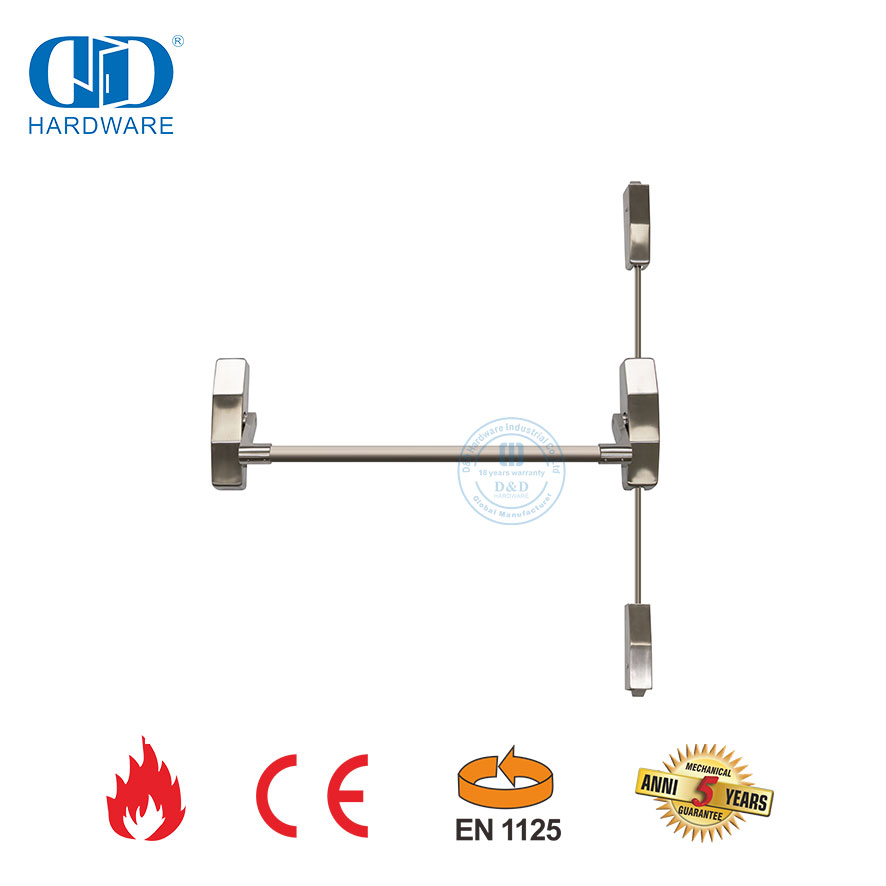
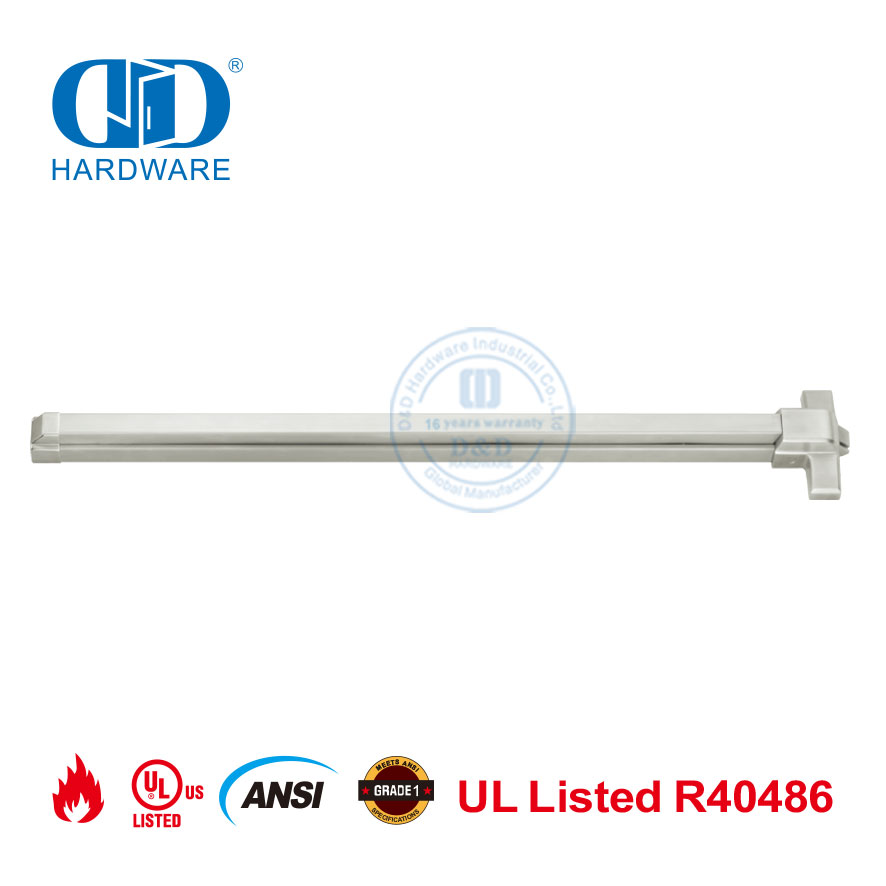

Below are some of the most common application scenarios.
Schools and universities require hardware that supports both:
•Daily circulation
•Emergency evacuation
Classroom buildings, auditoriums, gyms, and cafeterias often experience heavy traffic during short periods of time.
Recommended applications include:
•Main exit doors
•Stairwell exits
•Assembly halls
•Sports facilities
In educational projects, panic bars help:
•Improve evacuation efficiency
•Reduce exit obstruction risks
•Support code compliance for public occupancy buildings
Durability is especially important because doors in these environments are subject to constant use.
Healthcare buildings present unique evacuation challenges because occupants may include:
•Patients with limited mobility
•Elderly individuals
•Medical staff moving equipment
Exit hardware must therefore provide:
•Easy operation
•Reliable egress
•Smooth door control
In hospitals, panic hardware is commonly used on:
•Fire escape routes
•Stairwell doors
•Emergency corridors
•Large assembly spaces
Corrosion resistance also becomes important due to intensive cleaning procedures and hygiene requirements.
Retail environments often contain:
•Large crowds
•Multiple tenant exits
•Long evacuation paths
During emergencies, panic bars allow occupants to exit quickly without needing keys, handles, or special instructions.
Typical applications include:
•Mall corridor exits
•Fire escape routes
•Loading area exits
•Food court emergency exits
For high-traffic retail projects, durability and fire-rating performance are especially important.
Our EN1125 panic devices tested to 200,000 cycles are designed specifically for these demanding environments.
Airports, train stations, and metro terminals require some of the most durable exit hardware systems available.
These buildings operate continuously and experience:
•Heavy pedestrian traffic
•Large crowd movement
•Strict fire safety regulations
In transportation projects, panic bars are frequently installed on:
•Platform exits
•Emergency stairwells
•Public access corridors
•Restricted operational zones
In these environments, hardware failure is not acceptable.
This is why certified UL and CE panic hardware is widely specified in transportation infrastructure projects.

Selecting the correct panic bar involves more than choosing appearance or dimensions.
Several key factors should always be evaluated.
For fire doors, panic hardware must be tested as part of a fire-rated assembly.
Important certifications include:
•EN1634
•UL 10C
Using non-fire-rated panic devices on fire doors may lead to:
•Inspection failure
•Non-compliance
•Unsafe evacuation conditions
Public buildings require hardware capable of continuous operation.
Cycle testing is critical.
Our EN1125 panic devices are tested to:
•200,000 cycles
This ensures long-term reliability in demanding environments.
In humid or coastal environments, corrosion can affect hardware performance.
EN1670 corrosion resistance testing (240 hours) helps ensure:
•Longer service life
•Reduced maintenance
•Stable operation over time
Different projects specify different compliance systems.
CE projects commonly require:
•EN1125
•EN1634
North American and international projects often require:
•UL 10C
•UL305
Selecting certified products early helps simplify:
•Project approval
•Documentation
•Inspection processes
Over the years, we have seen several recurring issues in commercial projects:
1. Using Standard Exit Devices Instead of Certified Panic Hardware
This creates compliance and safety risks.
2. Incorrect Door Closer Adjustment
Poor closing speed affects latching performance.
3. Mismatched Fire Ratings
All hardware must align with the door assembly rating.
4. Poor Installation Quality
Improper installation can compromise emergency operation.
5. Ignoring Usage Frequency
Low-grade hardware often fails prematurely in public buildings.

A panic bar does not function independently.
Its performance depends on:
▪Door closers
▪Hinges
▪Locks
▪Door alignment
▪Fire-rated seals
This is why we always recommend viewing exit doors as a complete hardware system, rather than separate components.
A properly configured system improves:
▪Safety
▪Compliance
▪Long-term reliability
▪Installation efficiency
1. What is the difference between panic hardware and standard exit hardware?
Panic hardware is specifically designed for fast emergency egress in public buildings and is typically certified under EN1125 or UL305 standards.
2. Can panic bars be used on fire-rated doors?
Yes, but only if the panic device itself is fire-rated and tested under standards such as EN1634 or UL 10C.
3. Why are panic bars required in public buildings?
They allow occupants to exit quickly and intuitively during emergencies, reducing evacuation risks in high-occupancy environments.
4. What certifications are important for panic hardware?
The most common international certifications include:
▪EN1125
▪EN1634
▪UL305
▪UL 10C
5. How important is cycle testing for panic devices?
Very important. High-traffic buildings require hardware tested for long-term durability, such as 200,000-cycle performance testing.
6. Why is corrosion resistance important for panic bars?
Corrosion resistance improves long-term reliability, especially in humid, coastal, or heavily cleaned environments.
Click here for additional details on fire rated door hardware.
Now contact us.
Contact information for David Jian
Contact number: 0086-139 2903 7292
Email address: sales@danddhardware.com


