Certified for Safety. Trusted by Leaders Worldwide.
Pls inquire to sales@danddhardware.com
\\: +86 139 2903 7292

 English
 Author: D&D Hardware Publish Time: 2026-05-28 Origin: D&D Hardware


Managing a large-scale commercial construction project requires balancing architectural vision, building safety, and long-term durability. Among the thousands of moving parts in high-rise buildings, hospitals, schools, and shopping malls, fire door hardware often seems like a minor detail—until compliance checks, fire inspections, or heavy daily traffic reveal the true stakes.
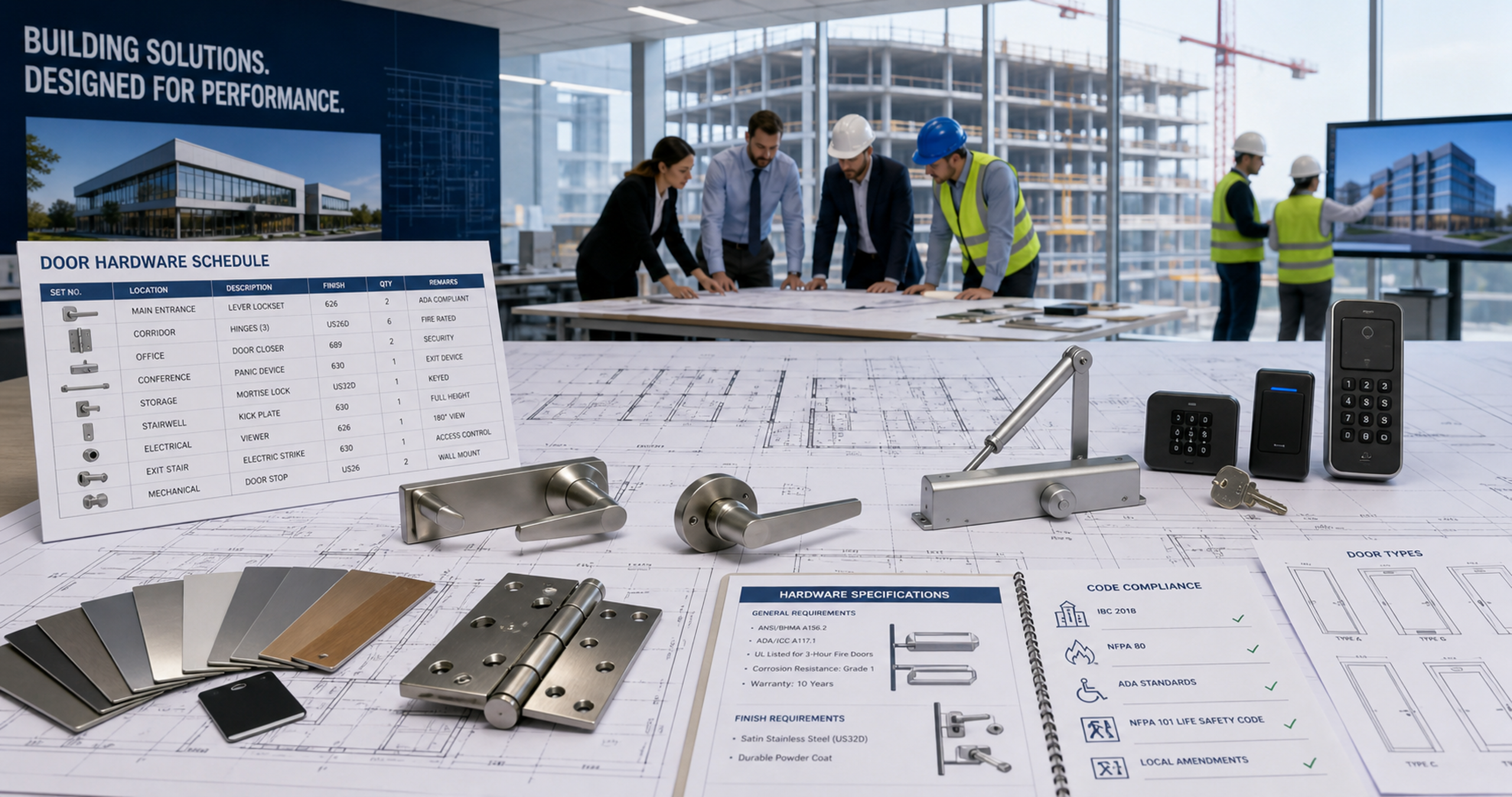
For modern commercial developments, door hardware is not a mere accessory; it is a critical life-safety component. Incorrect planning leads to failed inspections, compromised structural safety, and astronomical replacement costs. As a dedicated fire door hardware manufacturer, D&D HARDWARE understands that large-scale projects demand robust, certified, and application-specific solutions.
This comprehensive guide explores how to effectively plan door hardware for complex architectural applications while ensuring strict adherence to international fire safety standards.
In large-scale construction, delayed door hardware specification is a recipe for logistical bottlenecks. Waiting until the later stages of a build to source hinges, locks, and closers frequently results in mismatched pre-drilled doors, incompatible frames, and unexpected certification gaps.
Early-stage planning ensures that every component integrates seamlessly with the specific building type and its unique traffic patterns. A hospital corridor door, for instance, requires entirely different cyclic durability and opening force parameters than a mechanical room door in an industrial facility. By mapping out a detailed hardware schedule during the design or early procurement phase, project managers can prevent costly on-site modifications, streamline the installation workflow, and ensure that the entire door assembly functions as a unified life-safety barrier.

When a fire breaks out in a commercial building, compartmentalization is the primary defense mechanism to contain smoke and flames, protecting egress routes for occupants. A fire-rated door is only as reliable as the hardware holding it together. If a hinge warps under extreme heat, or if a door closer fails to latch properly, the entire fire barrier is compromised.
As an established fire door hardware manufacturer, our manufacturing philosophy at D&D HARDWARE centers on absolute reliability under pressure. We design, engineer, and test our products to survive extreme thermal duress and mechanical stress. Working directly with a specialized manufacturer gives project specifiers the confidence that every single item—from the internal lock chassis to the external panic bar—is engineered specifically to meet stringent global fire containment standards.
For projects adhering to European standards and British Standards (BS EN), hardware must withstand rigorous mechanical endurance, fire exposure, and corrosion resistance testing.
Our D&D CE Series Hardware is engineered precisely to meet these demanding architectural specifications across various applications:
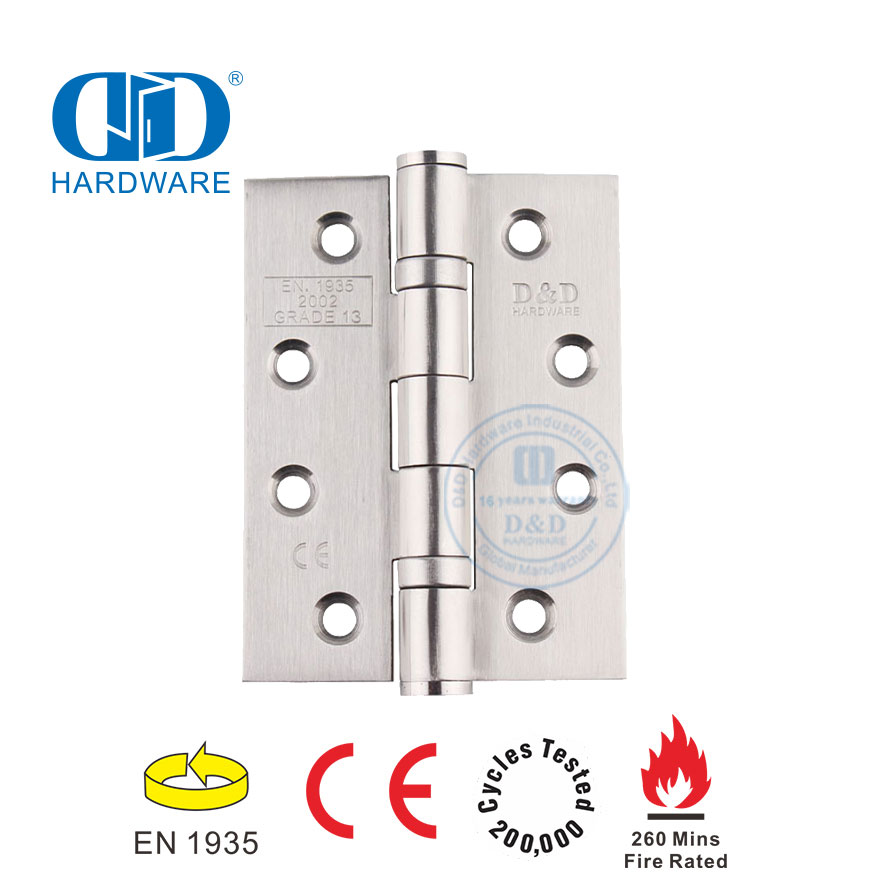
•Door Hinges (BS EN1935): Certified for 200,000 cycles, featuring an exceptional EN1634 fire rating of 192 minutes to 260 minutes, and EN1670 Grade 4 corrosion resistance (240 hours). These are built for high-frequency public entrance doors.
•Concealed Hinges (BS EN1935): Combining minimalist aesthetics with safety, providing a 200,000 cycles test life, 132-minute fire rating, and 48-hour corrosion resistance.
•Door Locks (BS EN12209): Tested for 200,000 cycles, offering fire containment from 111 minutes up to 260 minutes, alongside 240-hour corrosion resistance.
•Door Closers (BS EN1154): The backbone of controlled closing, tested to a staggering 500,000 cycles, with a 120 to 180-minute fire rating and 96-hour corrosion resistance.
•Door Handles (BS EN1906): Engineered for high-abuse environments with a 300,000 cycles test standard, 183 to 260-minute fire ratings, and 240-hour corrosion resistance.
•Lock Cylinders (BS EN1303): Providing secure access control with a 100,000 cycles test standard, 183-minute fire rating, and 96-hour corrosion resistance.
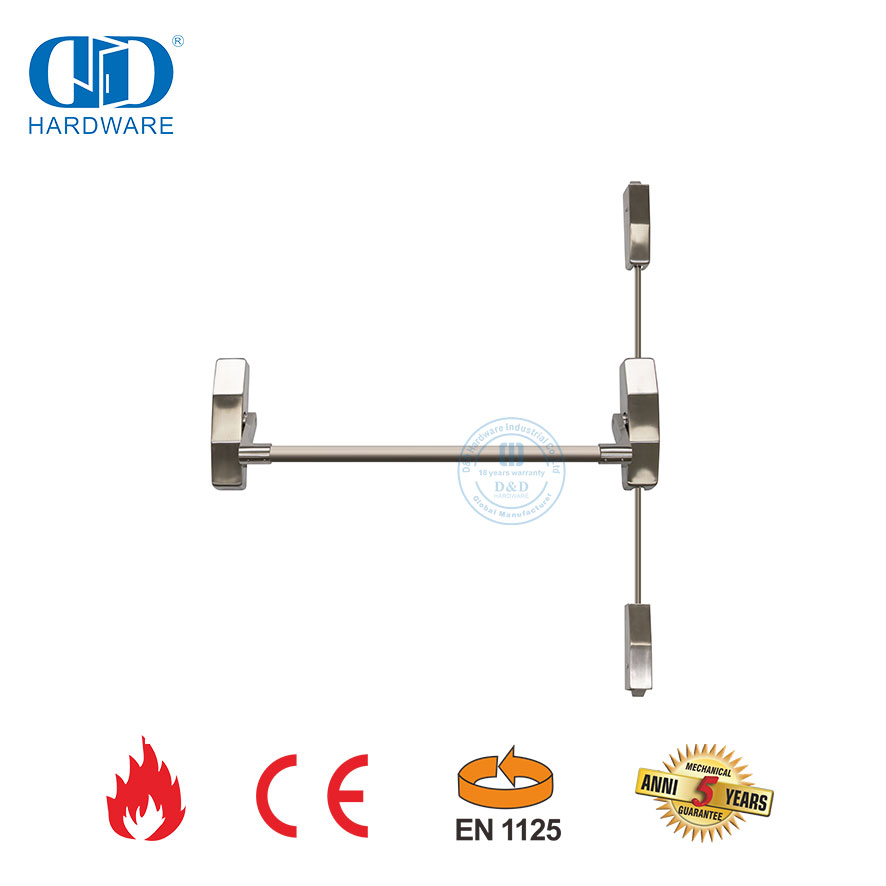
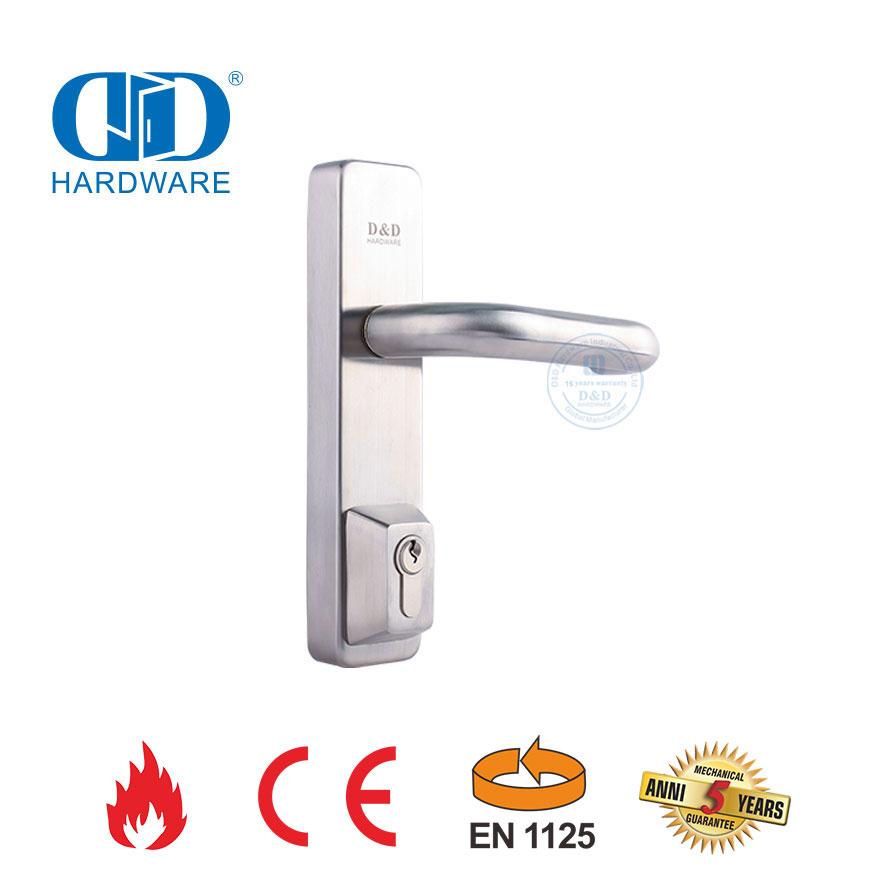
•Panic Exit Devices (BS EN1125): Critical for high-occupancy emergency paths, tested for 200,000 cycles, yielding a 132 to 240-minute fire rating and 240-hour corrosion resistance.
D&D CE Series Performance Matrix
Hardware Type | Standard | Endurance Testing | Fire Rating (EN1634) | Corrosion Resistance (EN1670) |
Door Hinge | BS EN1935 | 200,000 Cycles | 192 / 260 Mins | 240 Hours |
Concealed Hinge | BS EN1935 | 200,000 Cycles | 132 Mins | 48 Hours |
Door Lock | BS EN12209 | 200,000 Cycles | 111 / 260 Mins | 240 Hours |
Door Closer | BS EN1154 | 500,000 Cycles | 120 / 180 Mins | 96 Hours |
Door Handle | BS EN1906 | 300,000 Cycles | 183 / 260 Mins | 240 Hours |
Lock Cylinder | BS EN1303 | 100,000 Cycles | 183 Mins | 96 Hours |
Panic Exit Device | BS EN1125 | 200,000 Cycles | 132 / 240 Mins | 240 Hours |
For construction projects operating under North American building codes or international zones requiring UL/BHMA certification, hardware must comply with the stringent UL 10C positive pressure fire tests.
Our D&D UL Series Hardware delivers maximum protection for heavy-duty commercial configurations:
•Door Hinges (UL/cUL): Rated for UL 10C 3-Hour Fire Exposure (File No. R38013) and certified to meet ANSI/BHMA Grade 1 & Grade 2 heavy-duty mechanical requirements.
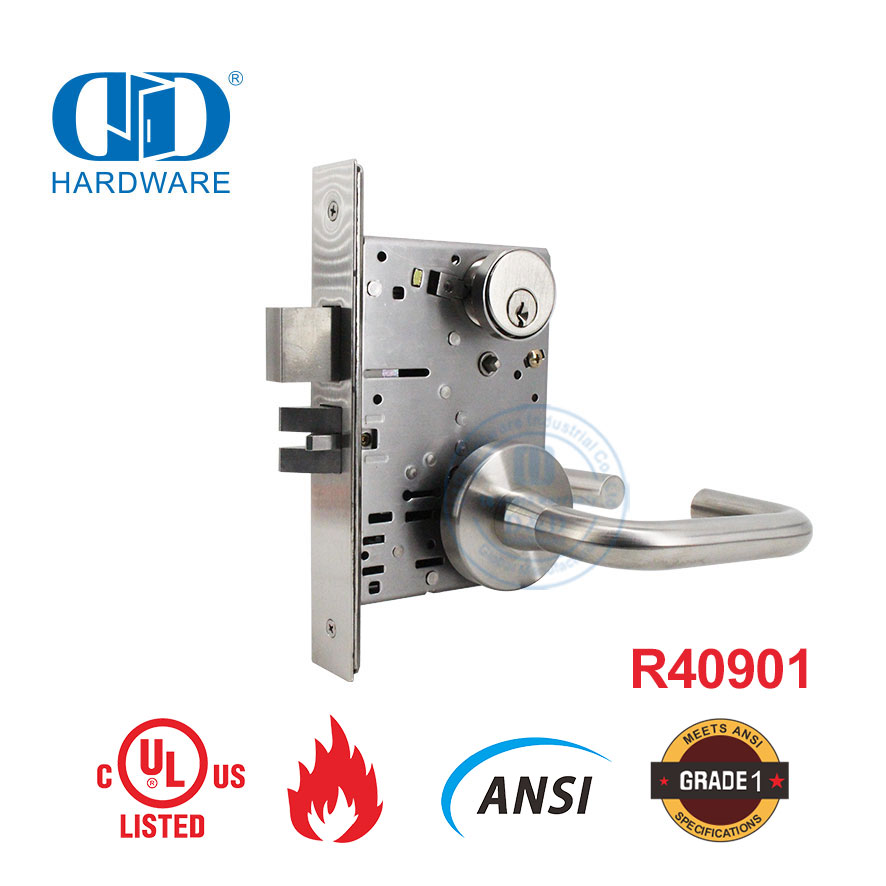
•Door Locks: Providing robust security and complete compartmentalization with a UL 10C 3-Hour Fire Rating (File No. R40901).
•Door Closers: Ensuring reliable, automatic door self-closing functionality under fire conditions, certified with a UL 10C 3-Hour Fire Rating (File No. R40717).
•Fire Exit Hardware: Specially engineered for designated fire doors requiring panic egress capabilities, certified with a UL 10C 3-Hour Fire Rating (File No. R40486).
•Panic Hardware: Certified under UL305 (File No. SA45817) for reliable emergency egress performance in high-occupancy assembly spaces.
Different commercial environments generate distinct physical demands on a door assembly. A comprehensive hardware plan must analyze the application scenario carefully:
1. Healthcare Facilities & Hospitals
Hospitals feature high-frequency cart traffic, demanding heavy-duty hinges capable of supporting wide doors, and robust door closers with backcheck functions to prevent wall damage. Corridors require high-hour fire-rated locks and smooth-operating door handles tested to hundreds of thousands of cycles to withstand constant usage.
2. High-Rise Commercial Office Buildings
Office developments prioritize a blend of security, aesthetics, and code compliance. Concealed hinges are often favored for sleek interior designs, while stairwell exit doors require heavy-duty fire-rated panic exit hardware or premium fire-exit devices to guarantee safe evacuation routes down the core of the building.
3. Educational Institutions & Schools
School hardware must withstand deliberate abuse and heavy student traffic. Hardware specified for classrooms requires maximum cyclic endurance (such as our 500,000-cycle door closers and 300,000-cycle door handles) and reliable locking mechanisms that ensure rapid lockdown capabilities when required.

Beyond fire protection and mechanical wear, environmental conditions play a massive role in the lifespan of door hardware. Coastal projects, chemical laboratories, humid tropical climates, and high-traffic public washrooms expose metal hardware to severe atmospheric oxidation.
If the base material or plating fails, internal springs snap, latches stick, and hinges seize—rendering a fire door completely inoperable. This is why specifying high-grade stainless steel hardware with verified corrosion resistance (such as our 240-hour salt spray tested finishes) is vital. Ensuring your hardware package can withstand both fire and rust saves thousands of dollars in premature replacement costs and guarantees continuous compliance over decades of building operations.

Can CE certified hardware and UL listed hardware be used interchangeably on the same fire door?
Generally, no. Building codes dictate whether a project must adhere to European standards (EN) or American standards (UL/BHMA). Mixing certifications on a single door leaf can invalidate the fire door assembly's overall certification rating. It is imperative to source a dedicated hardware suite that matches the specific regulatory framework of the local jurisdiction.
What is the significance of the 500,000 cycles test for door closers?
The door closer is the mechanical heart of a fire door assembly, responsible for ensuring the door returns to a fully latched position after every opening. A 500,000-cycle test proves the internal hydraulic seals, fluid, and spring mechanisms can endure years of high-frequency operation without leaking or losing the closing force required to secure a heavy fire door.
Why is corrosion resistance testing important for interior commercial doors?
Interior doors in commercial buildings are frequently exposed to harsh cleaning chemicals, moisture, and high humidity (especially in healthcare facilities, schools, and commercial kitchens). Hardware with a high corrosion resistance rating (e.g., 240 hours salt spray testing) ensures that internal mechanisms do not rust or lock up, maintaining flawless operation during an emergency evacuation.
How does panic hardware differ from standard fire exit hardware?
While both facilitate emergency egress, standard panic hardware (certified under UL305 / EN1125) is designed for rapid exit on non-fire-rated doors in high-occupancy areas. Fire exit hardware carries additional internal components and materials engineered to withstand intense heat, ensuring the door remains firmly latched against positive fire pressures for up to 3 hours without warping outward.
Click here for additional details on door hardware.
Now contact us.
Contact information for David Jian
Contact number: 0086-139 2903 7292
Email address: sales@danddhardware.com