
Certified for Safety. Trusted by Leaders Worldwide.
Pls inquire to sales@danddhardware.com
\\: +86 139 2903 7292

 English
 Author: D&D Hardware Publish Time: 2026-01-21 Origin: D&D HARDWARE


When you install a new entry door, you are likely focused on the aesthetics, the security of the lock, or the insulation value of the material. Yet, the mechanical success of that door relies almost entirely on a small, often ignored component: the hinge. If you choose the wrong size, your door might sag, scrape against the floor, or fail to latch correctly, compromising both energy efficiency and security.
Exterior doors are significantly heavier than interior doors. They are thicker, often made of solid wood, steel, or fiberglass, and they must withstand wind, rain, and constant temperature fluctuations. Because of this added weight and environmental stress, standard interior hinges simply cannot do the job. You need hardware specifically engineered to handle the load.
Selecting the correct hinge involves more than just guessing the height. You must consider the door's thickness, its width, the frequency of use, and even specific safety codes. This guide breaks down exactly how to size your exterior door hinges to ensure your entryway remains secure, functional, and smooth-operating for years to come.
The height of the hinge is the most critical measurement to get right. If the hinge is too short, it won't have the structural integrity to hold the door up, leading to warping or hinge failure. The height you need is primarily determined by the thickness and width of the door itself.
For most residential and commercial exterior doors, the standard rule is simple: as the door gets thicker and wider, the hinge must get taller.
Here is a general sizing chart to help you match your door dimensions to the required hinge height:
Door Thickness | Door Width | Recommended Hinge Height |
|---|---|---|
1-3/8" | Up to 32" | 3-1/2" |
1-3/8" | 32" to 36" | 4" |
1-3/4" | Up to 36" | 4-1/2" |
1-3/4" | 36" to 48" | 5" |
2" to 2-1/2" | Up to 42" | 6" |
Most standard residential exterior doors are 1-3/4 inches thick. As you can see from the table, this typically requires a 4-1/2 inch hinge. Using a smaller 3-1/2 inch hinge (common on interior bedroom doors) on a heavy exterior door is a recipe for maintenance headaches down the road.

While height supports the weight, the width of the hinge determines the "throw"—or how far the door can swing open without hitting the trim or door casing.
If your hinge is too narrow, the door will hit the casing before it opens a full 180 degrees. If it is too wide, it may look disproportionate or require excessive mortising. For standard doors where the door sits flush with the casing, the width usually matches the height (e.g., a 4-1/2" x 4-1/2" hinge).
However, if you have thick trim or a deep inset, you need to calculate the minimum width required. The formula generally used by hardware professionals is:
(Door Thickness − Backset) × 2 + Required Clearance + Inset = Hinge Width
If you aren't sure, a standard square hinge (where width equals height) is the safest bet for flush doors. For doors with decorative heavy casing, consider upgrading to a "wide throw" hinge.

Not all metal is created equal. Two hinges might both be 4-1/2 inches tall, but one could be flimsy while the other is robust. This difference is defined by the "gauge," or the thickness of the metal used to make the hinge leaves.
For exterior door hinges, you generally want a thicker gauge than what is used indoors. This prevents the metal from bending under the weight of a heavy security door.
Door Type | Frequency of Use | Recommended Gauge |
|---|---|---|
Residential (Standard) | Low/Medium | 0.134" |
Commercial (Standard) | Medium | 0.134" - 0.145" |
Commercial (Heavy Duty) | High | 0.180" - 0.190" |
If you are installing door hinges for Government office buildings or high-traffic commercial entrances, you should always opt for Heavy Duty hinges (typically .180 gauge). These environments see thousands of cycles per year, and a standard residential gauge will wear down quickly, leading to door sagging.
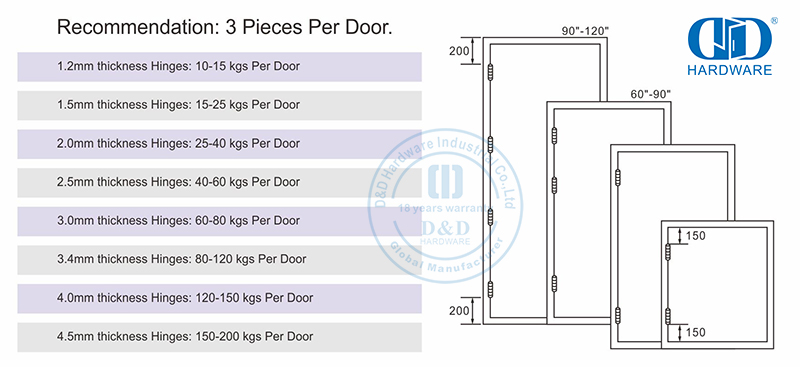
You might assume that every door just needs three hinges, but that depends entirely on the height of the door. Taller doors are prone to warping if they are not supported at correct intervals.
Standard 6-foot-8-inch doors usually require three hinges. However, grand entryways often feature 8-foot doors, which require additional support to keep the door sealed tight against the weatherstripping.
Door Height | Number of Hinges |
|---|---|
Up to 60" | 2 Hinges |
60" to 90" (Standard 7'0") | 3 Hinges |
90" to 120" (Tall 8'0"+) | 4 Hinges |
For every additional 30 inches of door height, you should add one additional hinge.
Exterior hinges face rain, humidity, UV rays, and potentially salt air if you are near the coast. A standard steel hinge will rust, sometimes within months.
For exterior applications, there are two primary material recommendations:
Solid Brass: Highly resistant to corrosion and offers a classic aesthetic. It is a softer metal, so it is often best for residential use rather than high-traffic industrial use.
Stainless Steel (Grade 304 or 316): This is the gold standard for durability. Grade 316 stainless steel is "marine grade" and is virtually impervious to rust. It provides the strength of steel with the longevity required for outdoor elements.
1
Yes. Commercial and government buildings have strict code requirements that residential homes often do not.
Fire Rated Door Hinges:
If your door is a fire door (common in garages leading to houses, or stairwells in office buildings), the hinges must be compliant. Fire rated door hinges must be made of steel or stainless steel; aluminum and brass are generally not permitted because they melt at lower temperatures. They must also be ball-bearing hinges to ensure the door closes completely every time. Look for hinges that carry the UL (Underwriters Laboratories) certification mark.
Door Hinges for Government Office:
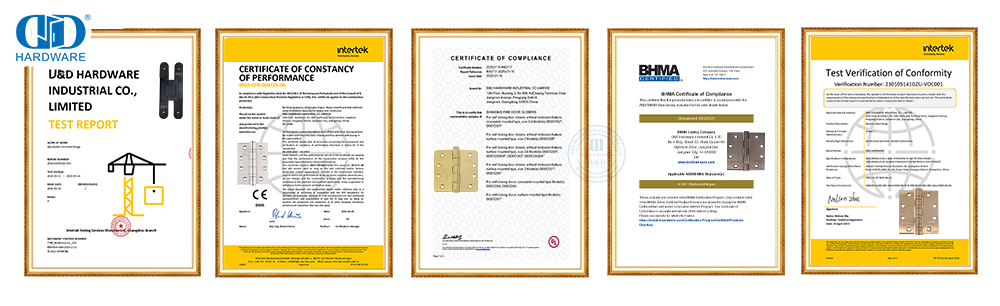
Government projects typically demand compliance with ANSI/BHMA standards. These standards (such as ANSI/BHMA A156.1) grade hardware based on durability and cycle testing. For a government office, you generally need Grade 1 or Grade 2 hinges, which are tested to withstand millions of open/close cycles without failure.
D&D Door Hinge Certification:
️✔ CE Door Hinge - BS EN1935 200,000 cycles test, EN1634 Fire Rated 192mins/260mins, EN1670 Corrosion Resistance 240 hours.
️✔ UL Door Hinge - UL/cUL Listed, UL 10C Fire Rated 3 Hours, File No.R38013
✔ BHMA Door Hinge - ANSI/BHMA 156.1 and ANSI/BHMA 156.18
✔ ANSI Door Hinge - ANSI Grade 1 2,500,000 cycles test, ANSI Grade 2 1,500,000 cycles test
✔ CE Concealed Hinge-BS EN1935 200,000 cycles test, EN1634 Fire Rated 132mins, EN1670 Corrosion Resistance 48 hours.
Choosing the right hinge size is about protecting your investment. A quality exterior door is expensive, but it can be ruined by a cheap, undersized hinge. By ensuring you have the correct height, width, gauge, and base material, you ensure that your door operates smoothly and keeps your building secure.
Whether you are outfitting a cozy home entrance or sourcing door hinges for Government office projects, precision matters. Always verify your measurements twice and look for certified hardware that meets the specific demands of your environment.
Click here for additional details on door hinges.
Now contact us.
Contact information for David Jian
Contact number: 0086-139 2903 7292
Email address: sales@danddhardware.com


