Certified for Safety. Trusted by Leaders Worldwide.
Pls inquire to sales@danddhardware.com
\\: +86 139 2903 7292

 English
 Author: D&D Hardware Publish Time: 2026-01-13 Origin: D&D HARDWARE


When you approach a building, you likely notice the handle design or the material of the entry door first. Yet, the components doing the heavy lifting are often ignored until something goes wrong. The hinges are the unsung heroes of any entryway, responsible for supporting the door’s weight and ensuring it swings smoothly thousands of times over its lifespan. If the spacing is off, even by a fraction of an inch, the door can sag, bind against the frame, or fail to seal properly against the weather.
Correct hinge spacing is not just a matter of aesthetics; it is a structural necessity. For exterior doors, which are typically heavier than interior ones due to solid cores or metal cladding, the placement of these pivot points dictates how well the weight is distributed. Improper installation can lead to security vulnerabilities, drafts that ruin your energy efficiency, and premature wear on the hardware itself.
Whether you are a contractor installing a new entry system or a homeowner looking to replace an aging door, understanding the standard measurements is critical. This guide breaks down the industry standards for hinge placement, the differences between residential and commercial requirements, and how to measure correctly to ensure a perfect fit.
To understand why standards exist, we must look at the forces acting on a door. Gravity is constantly pulling the door down, while the frame holds it upright. This creates tension on the top hinge and compression on the bottom hinge.
The top hinge carries the majority of the vertical load (the weight of the door). This is why you will often see heavy-duty exterior door hinges reinforced with longer screws that bite deep into the wall stud, not just the jamb. The bottom hinge acts as a stabilizer, keeping the door from kicking inward or twisting. The middle hinge, if present, helps keep the door straight and prevents bowing, which is common in taller or wooden doors.

For most standard residential doors in the United States, there is a widely accepted "rule of thumb" for spacing. While some custom manufacturers have their own specifications, the general industry standards are designed to ensure compatibility and structural integrity.
The center of the top hinge is typically placed 5 to 7 inches down from the top edge of the door slab (or the header of the jamb). This high placement is crucial for combating that gravitational pull mentioned earlier.
The center of the bottom hinge is generally positioned 10 to 11 inches up from the bottom edge of the door slab.
If a third hinge is required, it is usually centered exactly between the top and bottom hinges. This equidistant spacing provides balanced support and prevents the door from warping in the center.
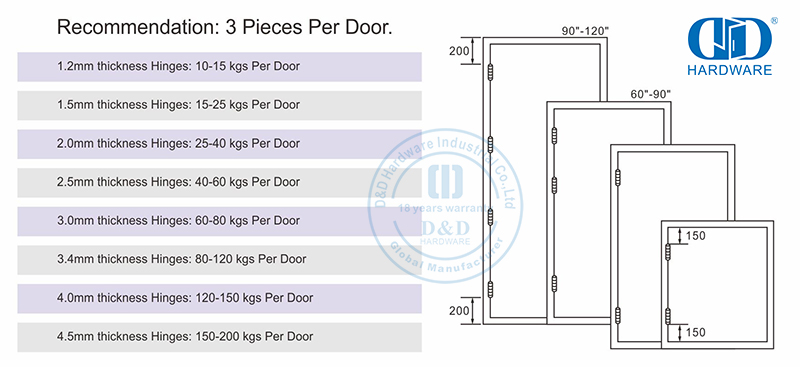
The number of hinges you need depends almost entirely on the height and weight of the door. Using too few hinges on a heavy exterior door will lead to rapid failure.
Doors up to 60 inches: Generally require 2 hinges.
Doors 60 to 90 inches (Standard 6'8" and 7'0" doors): Require 3 hinges. This is the most common setup for residential entryways.
Doors 90 to 120 inches: Require 4 hinges to support the additional height and weight.
1
The following table outlines the general guidelines used by carpenters and hardware manufacturers for standard exterior doors.
Door Height | Number of Hinges | Top Hinge Location | Bottom Hinge Location | Intermediate Hinges |
|---|---|---|---|---|
Up to 60" | 2 | 5" from top | 10" from bottom | N/A |
60" - 90" | 3 | 5" - 7" from top | 10" - 11" from bottom | Centered between top and bottom |
90" - 120" | 4 | 5" - 7" from top | 10" - 11" from bottom | Spaced equally between top and bottom |

While residential wood doors have some flexibility, commercial applications usually follow stricter codes, often dictated by the Steel Door Institute (SDI) or specific fire ratings.
When dealing with a steel door hinge installation on a hollow metal frame, precise alignment is non-negotiable. Metal doors do not "give" or settle like wood; if the spacing is wrong, the door simply will not close.
In commercial settings, you will often find the top hinge located exactly 5 inches from the top of the door to the top of the hinge (not the center). The bottom hinge is often 10 inches from the bottom of the finished floor to the bottom of the hinge.
For public infrastructure, durability is the priority. Consider a heavy door hinge for station entrances, subway platforms, or busy office buildings. These doors open hundreds of times a day. In these scenarios, engineers might specify four hinges on a standard height door or use continuous "piano" hinges to distribute the load along the entire length of the frame. This prevents the top hinge from tearing out under the stress of constant abuse and heavy closers.
If you are replacing an existing door slab but keeping the old frame, you cannot rely on the "standard" measurements. You must match the existing mortise cuts on the jamb. Here is how to measure accurately:
Measure from the Top: Hook your tape measure on the very top edge of the door slab (or the rabbet of the jamb header).
Top of Hinge: Measure down to the top edge of the top hinge leaf. Note this measurement.
Repeat: Measure from the top of the door to the top edge of the middle and bottom hinges.
Check Size: Measure the height and width of the hinge itself (e.g., 4 inches x 4 inches).
Corner Radius: Determine if the corners are square or rounded (1/4 inch or 5/8 inch radius).
1
Proper hinge spacing is the foundation of a functional door. While the standard 5-to-7-inch top and 10-to-11-inch bottom spacing works for most situations, always verify the specific requirements of your door material and manufacturer. A well-hung door offers better security, superior insulation, and smooth operation for years to come.
If you are sourcing hardware for a large-scale project or require specialized guidance on fire-rated or commercial door solutions, contact the experts at D&D Hardware to discuss your specific needs.
Click here for additional details on door hinges.
Now contact us.
Contact information for David Jian
Contact number: 0086-139 2903 7292
Email address: sales@danddhardware.com