
Certified for Safety. Trusted by Leaders Worldwide.
Pls inquire to sales@danddhardware.com
\\: +86 139 2903 7292

 English
 Author: D and D Hardware Publish Time: 2026-03-05 Origin: D and D Hardware


A fire breaks out on the third floor of a crowded office building. Smoke fills the stairwells. People rush toward the nearest exit door—only to find themselves fumbling with a standard lock handle in the chaos. Seconds are lost. In emergency evacuations, seconds matter.
This is precisely the problem that panic bars solve. Also known as crash bars or push bars, these horizontal exit devices allow doors to be opened with a single push—no turning, no twisting, no fumbling. For building managers, contractors, and facility owners, understanding when a panic bar is required (and when it's simply the right call) is an essential part of responsible building management.
So, do you need one? The answer depends on your building type, occupancy load, and local fire safety codes. This guide breaks it all down.
A panic bar is a horizontal bar mechanism mounted across the interior of an exit door. When pressed, it releases the door latch and allows the door to swing open immediately. The design is intentional: in a high-stress emergency, people naturally push against a door rather than search for a handle or turn a knob.
Panic bars are most commonly found on fire exit doors in public buildings—schools, hospitals, shopping centers, office towers, and entertainment venues. They are a core component of fire exit door hardware systems and are often required by building codes in many countries.

Requirements vary by jurisdiction, but most building codes and fire safety regulations draw from established standards such as NFPA 101 (Life Safety Code) in the United States, or equivalent standards in the UK and Europe.
As a general rule, a public building panic bar is typically required when:
The building has an occupant load of 50 or more people in a space
The door serves as a required egress exit (meaning occupants must use it to evacuate)
The building is classified as a high-hazard occupancy, such as a factory, storage facility, or industrial site
The exit door is part of a fire-rated assembly, which calls for fire exit door panic bar hardware specifically rated for that purpose
In the United States, NFPA 101 and the International Building Code (IBC) both specify that panic hardware is mandatory on doors serving assembly occupancies with 50 or more occupants, and on all high-hazard occupancy exits regardless of occupant load.
If your building falls into any of these categories, fitting a panic bar isn't just a good idea—it's a legal requirement.
Not every building is the same, but the following facility types almost universally require panic bar hardware on fire exit doors:
Classrooms, gymnasiums, and auditoriums regularly hold large groups of people. A fire exit door panic bar ensures that students and staff can evacuate quickly and without confusion, even in a high-stress situation.
In healthcare environments, exits must be accessible to patients who may be disoriented, in wheelchairs, or accompanied by medical staff. Panic bars allow doors to be opened with minimal effort—a critical feature when speed and accessibility both matter.
Once occupancy exceeds 50 people, most commercial office buildings are required to have panic hardware on designated exit routes. High-rise buildings, in particular, rely on panic bar-equipped stairwell doors as primary evacuation routes.
High foot traffic combined with limited familiarity with the building layout makes panic bars essential in retail environments. Shoppers in a fire emergency are unlikely to know where standard door handles are or how to operate them under pressure.
These are among the highest-risk environments for crowd-related emergencies. Panic bars are almost universally mandated for any exit serving large assembly spaces.
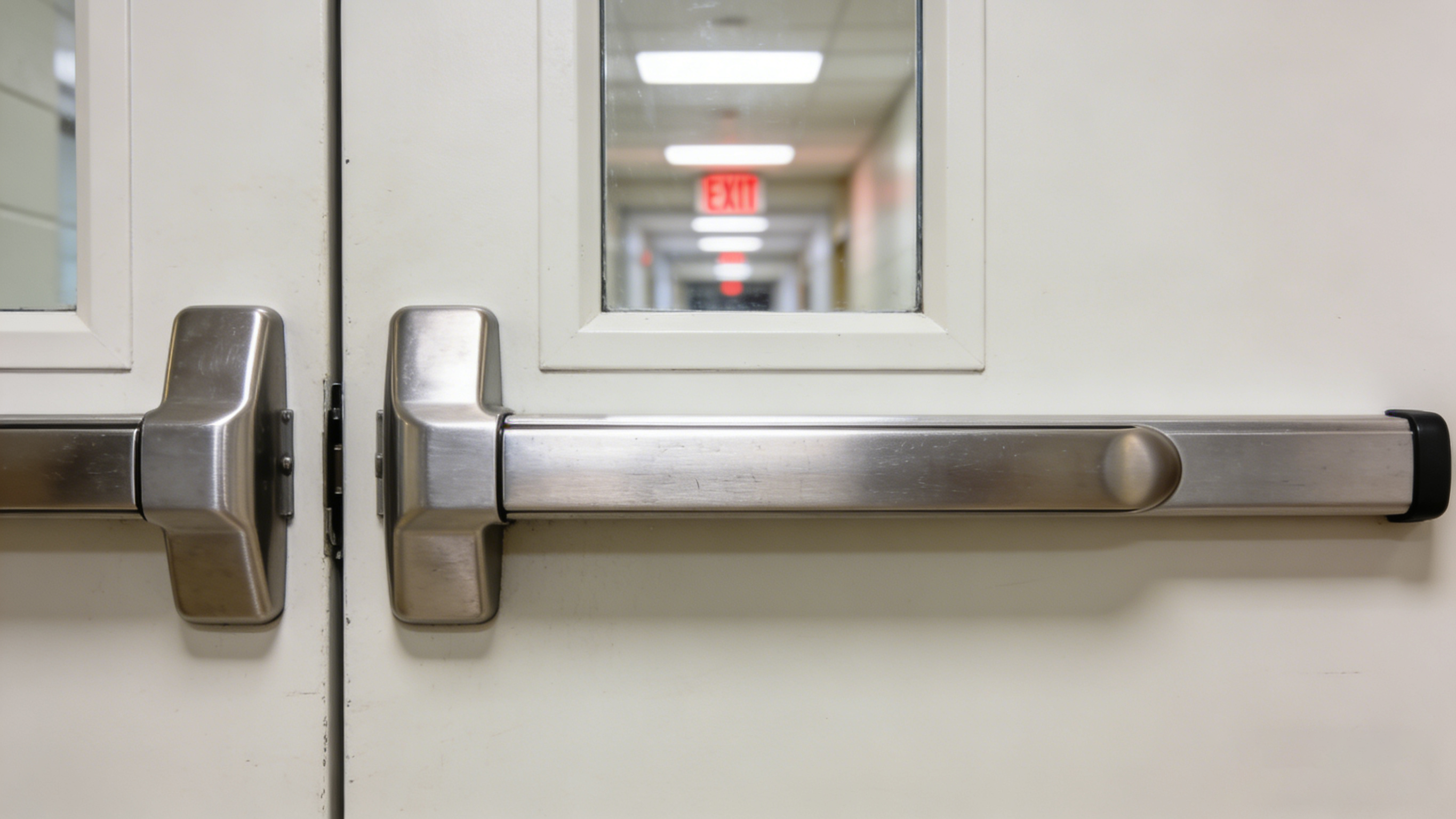
A standard panic bar and a fire exit door panic bar are not the same thing. Fire-rated exit hardware must meet additional requirements to ensure it performs under extreme conditions—specifically, it must maintain its function and structural integrity when exposed to high temperatures during a fire.
In the US, fire exit door panic bar hardware is typically required to meet UL 10C certification (Positive Pressure Fire Tests of Door Assemblies). This means the device has been tested to perform under positive pressure fire conditions—a more rigorous standard than older UL 10B tests.
Key features to look for in fire exit door hardware include:
UL 10C or equivalent fire rating for the complete door assembly
ANSI/BHMA Grade 1 certification, which reflects the highest level of performance for commercial hardware
CE marking for compliance in European markets
Compatibility with fire-rated door frames and closers
Installing a panic bar that hasn't been certified for fire-rated applications on a fire exit door creates a compliance gap—and a potential liability risk.
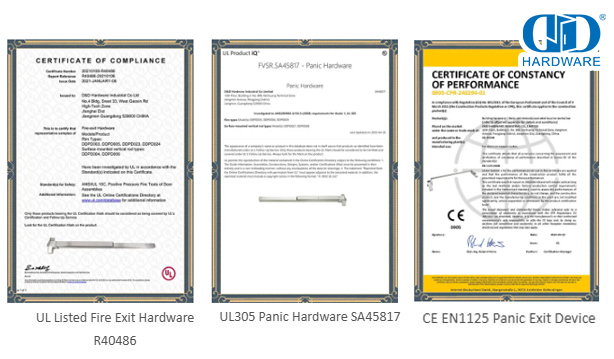
D&D Panic Exit Hardware Certification:
✔️ Panic Exit Device-BS EN1125 200,000 cycles test, EN1634 Fire Rated 132/240mins, EN1670 Corrosion Resistance 240 hours.
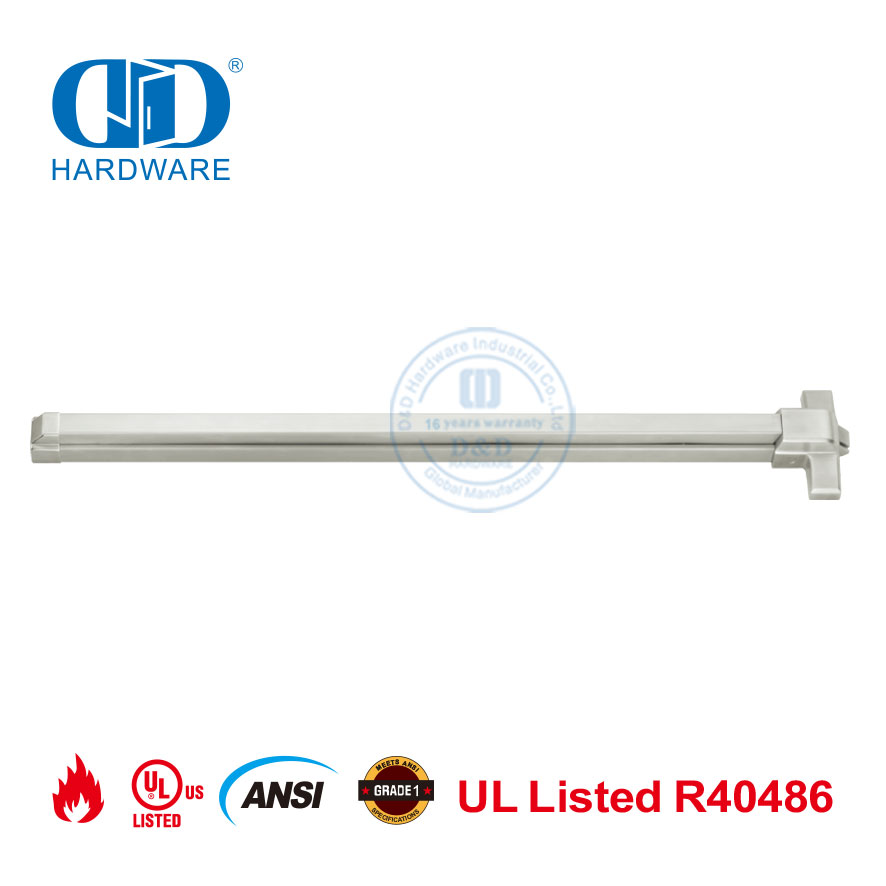
✔️ Fire Exit Hardware- UL 10C Fire Rated 3 Hours, File No.R40486
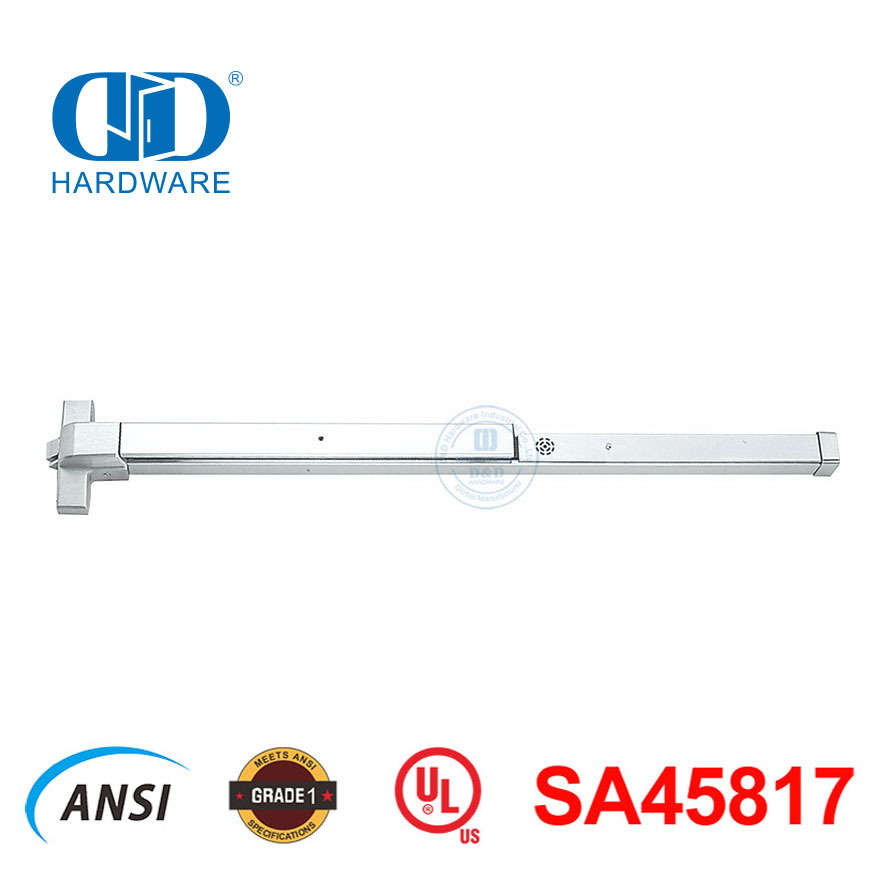
✔️ Panic Hardware-UL305, File No.SA45817
Not all panic bars are built the same way. The right choice depends on your door type, security requirements, and fire rating needs.
Rim Panic Devices: The most common type. The latch mechanism mounts on the surface of the door. Suitable for single doors in most commercial applications.
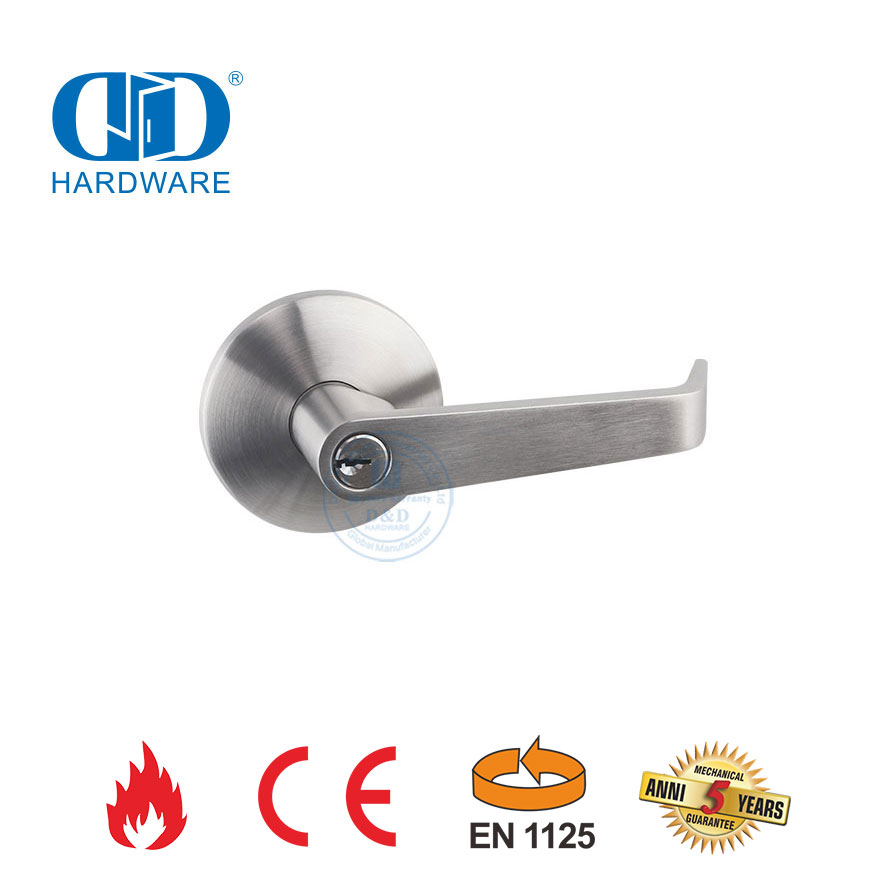
Mortise Panic Devices: The lock mechanism is embedded within the door itself, offering enhanced security. Common in high-traffic or high-security environments.
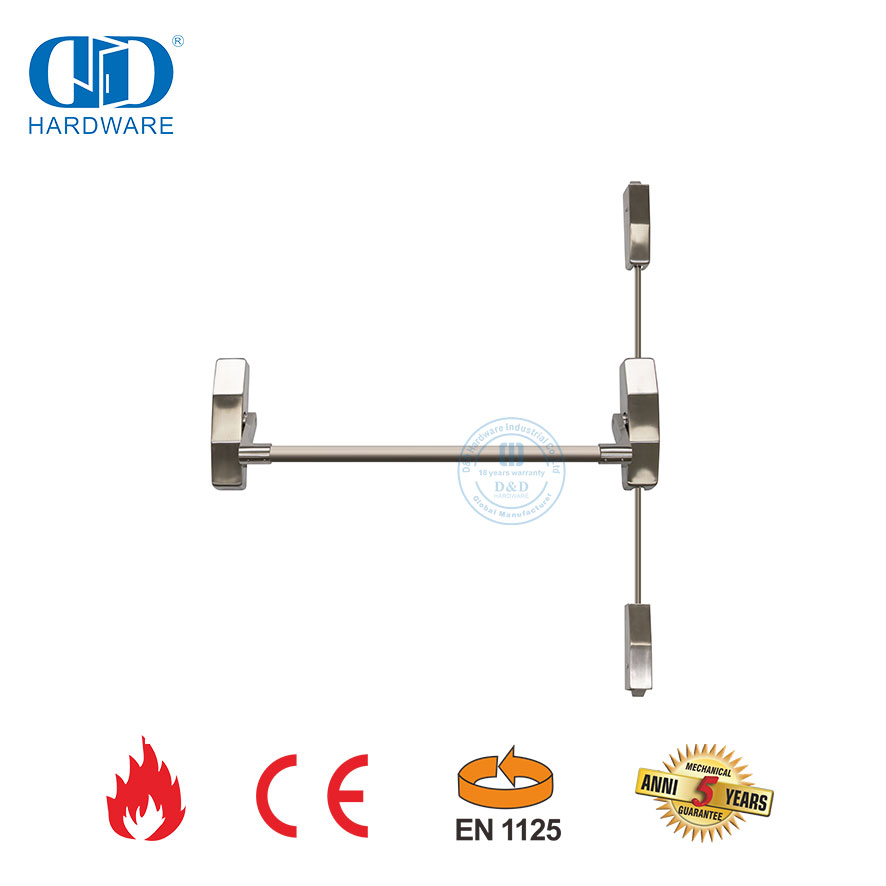
Vertical Rod Panic Devices: Operate latches at both the top and bottom of the door. Used on double doors or where additional security is needed.
Concealed Vertical Rod Devices: Similar to vertical rod types, but the rods are hidden inside the door. Preferred for aesthetic installations.
For fire exit door applications, the device must be paired with a compatible door closer to ensure the door closes and latches automatically after use—this is a non-negotiable requirement in fire-rated assemblies.
Even when panic bars are installed, compliance issues often arise from improper hardware selection or installation. Watch out for these common errors:
Using non-fire-rated hardware on fire exit doors. The panic bar, door closer, hinges, and frame must all be fire-rated as a complete system.
Incorrect door closer selection. A panic bar on a fire exit door without a properly rated door closer can cause the fire-rated assembly to fail inspection.
Ignoring local code amendments. National standards like IBC or NFPA 101 are often amended at the state or local level. Always verify with your local Authority Having Jurisdiction (AHJ).
Skipping third-party certification. Products carrying ANSI, UL, and CE certifications have been independently tested. Uncertified hardware offers no assurance of performance.

For building contractors, door manufacturers, and facility managers sourcing hardware for commercial projects, product certification and supplier reliability are critical. D&D Hardware (dnd-hardware.com) is a China-based manufacturer with over 17 years of experience producing door hardware for metal, wooden, and fire-rated door applications. Their panic exit devices carry UL 10C, ANSI/BHMA, and CE certifications, making them a viable option for both American and European market compliance requirements. They also offer full door hardware sets—including door closers, hinges, and lock cylinders—that can be configured as complete fire-rated door assemblies.
A panic bar is not just a piece of hardware. It is the last line of defense between an orderly evacuation and a dangerous bottleneck. For any public building with significant foot traffic, a fire exit door panic bar is both a regulatory requirement and a sound safety investment.
Review your building's occupancy classification, check applicable local codes, and ensure that any hardware you install carries the appropriate certifications for fire-rated and commercial use. When in doubt, consult a licensed fire safety engineer or your local AHJ before finalizing your specification.
The cost of getting this right is minimal. The cost of getting it wrong is not.
Click here for additional details on panic exit device.
Now contact us.
Contact information for David Jian
Contact number: 0086-139 2903 7292
Email address: sales@danddhardware.com


