
Certified for Safety. Trusted by Leaders Worldwide.
Pls inquire to sales@danddhardware.com
\\: +86 139 2903 7292

 English
 Author: D&D Hardware Publish Time: 2026-03-04 Origin: D&D HARDWARE


Hospitals never sleep. At any hour, staff are rushing between wards, patients are being wheeled through corridors, and emergencies can escalate without warning. In that kind of environment, every second counts—and the hardware on your doors matters more than most people realize.
A panic bar for hospital use isn't just a code requirement. It's one of the most practical safety investments a healthcare facility can make. This post breaks down what panic bars are, why they're so critical in medical settings, and what to look for when choosing one.
A panic bar—also called a crash bar or exit device—is a horizontal push bar mounted across an emergency exit door. Press it, and the door opens immediately, no keys or handles required. The mechanism is designed to work under pressure, even when someone is running, panicking, or pushing through a crowd.
That simplicity is exactly what makes it so valuable.
Medical institutions present challenges that most other buildings don't. Consider the following:
High foot traffic: Hospitals see hundreds to thousands of people daily—patients, visitors, nurses, doctors, and support staff all moving through the same corridors.
Mobility limitations: Many patients use wheelchairs, walkers, or stretchers. They can't fumble with door handles during an evacuation.
Time-critical emergencies: Whether it's a fire, a code blue, or a building lockdown, delays at exit points can cost lives.
Infection control: Touchless or low-contact door operation reduces the spread of pathogens—a concern that healthcare settings take seriously.
A medical institutions panic bar addresses all of these challenges at once. One firm push is all it takes to clear an exit, regardless of who's pushing or what they're carrying.

When an emergency strikes, the last thing you want is a bottleneck at the exit. Panic bars allow doors to open instantly with minimal force, helping large groups move through quickly and safely. This is especially important in areas like emergency rooms, ICUs, and surgical wings, where patients may be non-ambulatory.
Most building codes—including NFPA 101 (the Life Safety Code) and local fire regulations—require panic exit devices on certain doors in high-occupancy buildings. Hospitals fall squarely into this category. Installing a certified panic bar for healthcare facilities isn't optional in most jurisdictions; it's a legal requirement.
Standard door handles require gripping and turning. Panic bars require only a push, reducing hand-to-surface contact. In environments where cross-contamination is a constant concern, this is a meaningful advantage.
Hospital doors don't get a rest. They open and close hundreds of times a day. A high-quality panic bar—built from stainless steel or heavy-duty aluminum and certified to standards like UL, ANSI, or CE—can handle that volume without degrading in performance.

Not all exit devices are built the same. When selecting a panic bar for hospital or healthcare use, prioritize the following:
Certifications: Look for UL, ANSI/BHMA, or CE certification to confirm the product meets recognized safety and durability standards.
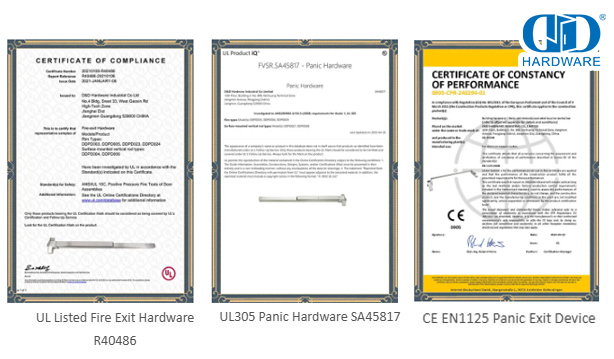
D&D Panic Exit Hardware Certification:
✔️ Panic Exit Device-BS EN1125 200,000 cycles test, EN1634 Fire Rated 132/240mins, EN1670 Corrosion Resistance 240 hours.
✔️ Fire Exit Hardware- UL 10C Fire Rated 3 Hours, File No.R40486
✔️ Panic Hardware-UL305, File No.SA45817
Fire rating compatibility: Many hospital doors are fire-rated. Your panic bar must be rated to match—typically UL 10C for positive pressure fire doors.
Corrosion resistance: Healthcare environments involve frequent cleaning with strong disinfectants. Choose finishes that can handle repeated chemical exposure.
Smooth operation: The push bar should engage and release cleanly, every time. Stiff or unreliable mechanisms create risk.
ADA compliance: In the US, exit hardware must meet ADA requirements to accommodate patients and staff with disabilities.
1
Hardware quality varies widely between manufacturers. For medical institutions, the consequences of a product failure aren't just financial—they're potentially fatal. That's why sourcing from a reputable, certified manufacturer matters.
D&D Hardware has over 18 years of experience producing certified door hardware, including panic exit devices that meet UL, CE, ANSI, and BHMA standards. Their products are designed for demanding commercial environments, making them well-suited for hospitals, clinics, and other healthcare facilities. Explore D&D Hardware's panic bar range here.
A panic bar for healthcare is a small investment with an outsized impact on safety. It speeds up evacuation, reduces infection risk, supports regulatory compliance, and holds up under the relentless demands of a working hospital. For any medical institution, it's not a nice-to-have—it's essential infrastructure.
Click here for additional details on panic exit device.
Now contact us.
Contact information for David Jian
Contact number: 0086-139 2903 7292
Email address: sales@danddhardware.com


