
Certified for Safety. Trusted by Leaders Worldwide.
Pls inquire to sales@danddhardware.com
\\: +86 139 2903 7292

 English
Author: Site Editor Publish Time: 2026-10-28 Origin: Site


Quick answer:
Railway Station Door Hardware and Metro Terminal Door Hardware must meet stricter demands than typical commercial buildings — 24/7 operation, platform-level fire compartmentalization, and surges of passenger traffic during peak hours. Key components include UL 10C fire-rated panic exit devices, durable door closers, ANSI Grade 1 mortise locks, and electronic access control for staff and control rooms. Underground stations also require corrosion- and moisture-resistant finishes.
Railway stations and metro terminals share some hardware needs with airports, but they aren't the same building type, and treating them as interchangeable leads to specification mistakes. Airports process passengers through long dwell times and extensive security screening. Train and metro stations, by contrast, move people through quickly, often in dense bursts tied to train arrivals, and many operate around the clock without the luxury of overnight closures for maintenance.
This distinction matters enormously for hardware selection. A door that performs well in a quiet airport lounge corridor may fail prematurely on a subway platform that sees thousands of cycles a day. This guide breaks down where railway and metro door hardware requirements diverge from general transportation hub standards, and what to specify for each functional zone of a station.
Airports and railway stations both fall under the "transportation hub" category, but the operational realities are different enough to warrant separate hardware strategies.
Airports typically have:
Longer dwell times and more controlled passenger flow through security checkpoints
Predictable peak periods tied to flight schedules
Climate-controlled interiors throughout
Railway stations and metro terminals typically have:
Near-continuous passenger flow with sharp peaks during commuter rush hours
Platform areas that are often semi-exposed or underground, introducing moisture and temperature swings
Fire compartmentalization requirements between platform, concourse, and tunnel or trackside areas
24-hour or near-24-hour operation in many urban systems, leaving minimal downtime for hardware servicing
Because of these differences, Metro Terminal Door Hardware specifications should prioritize cycle durability and fire separation at the platform level, areas that see far more frequent use and higher fire risk exposure than an airport's general circulation doors.
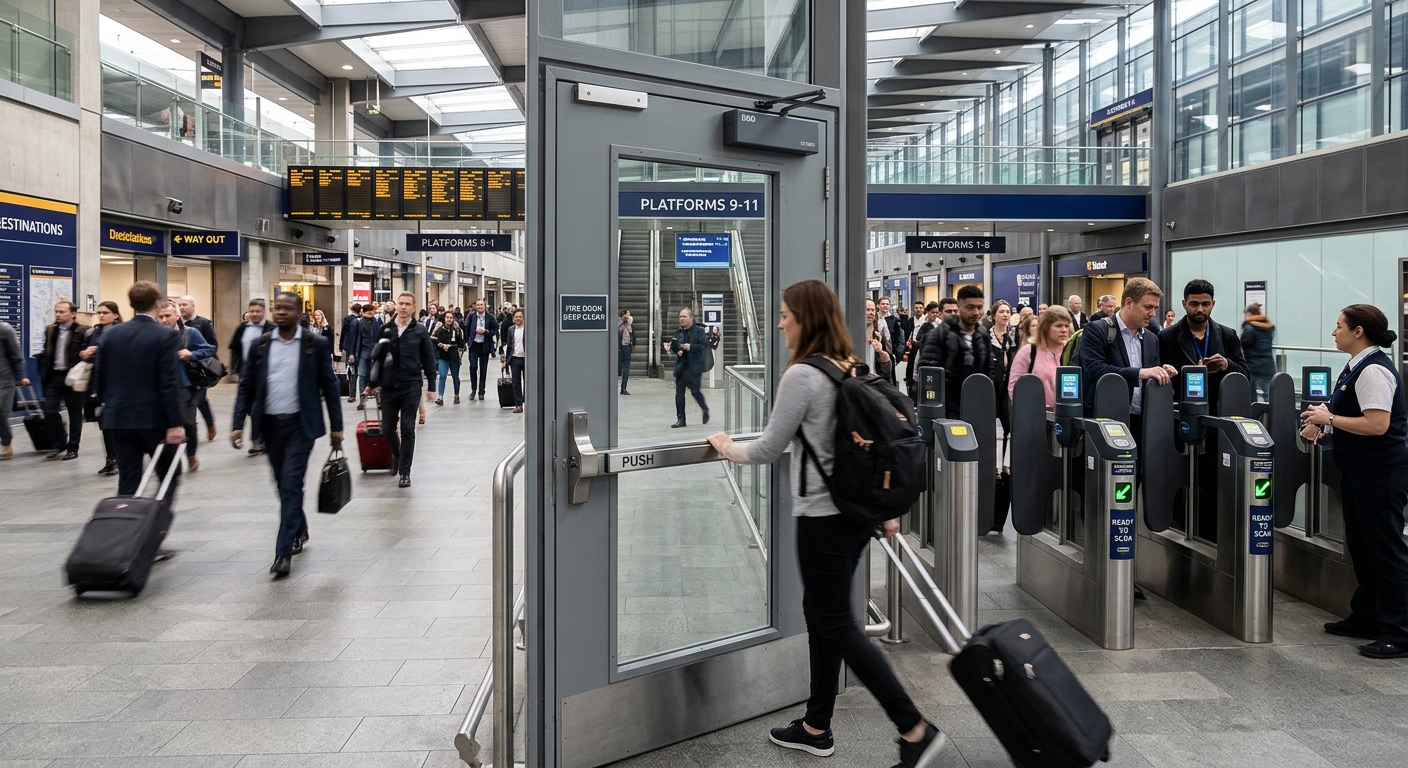
The platform is the highest-risk zone in any railway or metro station because it sits closest to the track and any potential fire, smoke, or electrical incident. Fire compartment doors separating platforms from concourses, stairwells, or tunnels need to perform two jobs simultaneously: they must allow immediate egress during an emergency, and they must self-close and maintain their fire rating the rest of the time.
For this application, specifiers should look for:
UL 10C-rated fire exit (panic exit) devices — a panic exit device for railway station platform doors needs to combine push-to-exit operation with positive latching, so the door can be fire-rated and still allow instant evacuation without requiring a key or extra motion.
UL 10C fire-rated door closers — these provide controlled closing force so the door consistently returns to its latched position after each use, which is essential for maintaining the fire compartment's integrity over thousands of daily cycles.
Choose fire-rated panic exit hardware over standard exit devices whenever a door separates a fire compartment, since general-purpose exit hardware is not tested or listed for that application.
Faregate and turnstile zones present a different challenge: speed. Passengers need to move through quickly without bottlenecking, but the station still needs to control who passes and when.
Electronic access control is the standard solution here. Doors adjacent to faregates, staff-only gates, and auxiliary entry points benefit from electronic locking integrated with the station's access management system, allowing operators to open, lock, or monitor doors remotely without manual intervention. This reduces staffing needs at secondary entry points while keeping the main passenger flow unobstructed.
Choose electronic access hardware if a door needs to be remotely monitored or scheduled (for example, opening only during specific service hours), and reserve mechanical locks for doors with simpler, static access requirements.
Behind the public-facing areas of any station are staff corridors, equipment rooms, and control rooms that require a different hardware approach entirely. These spaces don't see the traffic volume of platforms or concourses, but they do require strict access accountability.
A master key system paired with mortise locks is the typical specification for these areas. Mortise locks offer a higher security grade than cylindrical locks and can be configured within a hierarchical master key system, so station managers can grant broad access to supervisors while restricting individual staff to their specific work areas. Storage and equipment rooms, in particular, benefit from mortise locks rated for frequent use, since staff may access these spaces dozens of times per shift.
Peak commuter periods put enormous mechanical stress on door hardware. A busy metro entrance can see tens of thousands of open-close cycles daily, far beyond what standard commercial-grade hardware is built to handle.
This is why ANSI/BHMA Grade 1 should be treated as the minimum standard, not an upgrade, for any door hardware in high-traffic station zones. Grade 1 hardware is tested to the highest cycle and durability thresholds under ANSI/BHMA classifications, making it the appropriate baseline for concourse entrances, platform access doors, and any other high-frequency door within the station.
Choose Grade 1 hardware for any door facing direct commuter traffic, and reserve Grade 2 hardware for lower-traffic back-of-house applications where budget considerations may be more relevant than cycle life.
Underground metro stations introduce a hardware challenge that aboveground railway stations don't face as acutely: persistent moisture and the corrosion it causes. Humidity from tunnel ventilation systems, water infiltration, and temperature differentials between underground and surface levels all accelerate the degradation of untreated metal components.
Door hinges, closers, locks, and exit devices installed below grade should use corrosion-resistant finishes and materials suited to humid, below-ground environments. Specifying standard interior-grade finishes in these zones often leads to premature hardware failure, stiff operation, or visible corrosion well before the expected service life.
Railway Station Door Hardware and Metro Terminal Door Hardware projects involve more variables than a typical commercial building: fire compartmentalization, continuous operation, extreme traffic cycles, and in many cases, underground environmental exposure. Specifying hardware designed and certified for these conditions, rather than borrowing specifications from general commercial or even airport projects, is what keeps a station safe, compliant, and operational over the long term.
D&D HARDWARE INDUSTRIAL Co., Ltd. supplies CE, UL, and ANSI/BHMA certified door hardware — including panic exit devices, door closers, mortise locks, and electronic access solutions — suited to the demands of transportation infrastructure. If you're planning hardware specifications for a railway station, metro terminal, or similar high-traffic public facility, D&D Hardware's technical team can help match certified hardware to each zone's specific fire, security, and durability requirements.
What type of panic exit device is required for railway station platform doors?
Platform doors that separate fire compartments typically require a UL 10C-rated panic exit device, which combines push-to-exit operation with a fire-rated, positively latching mechanism.
Is ANSI Grade 1 hardware necessary for every door in a train station?
Grade 1 is recommended for doors facing direct passenger traffic, such as concourse entrances and platform access points. Lower-traffic, back-of-house doors can often use Grade 2 hardware instead.
Why can't airport door hardware specifications be reused for metro stations?
Airports and metro stations have different traffic patterns, operating hours, and fire compartmentalization needs. Metro stations typically require higher cycle durability and more platform-specific fire-rated hardware due to continuous, high-frequency use.
What hardware is recommended for underground or below-grade stations?
Corrosion-resistant hinges, closers, locks, and exit devices are recommended for underground stations, since humidity and water infiltration accelerate the wear of standard interior-grade finishes.
Who should be involved in selecting door hardware for a railway or metro project?
Station operators, fire safety consultants, and a certified door hardware supplier should coordinate early in the project to match hardware to each zone's fire rating, traffic volume, and access control requirements.


