
Certified for Safety. Trusted by Leaders Worldwide.
Pls inquire to sales@danddhardware.com
\\: +86 139 2903 7292

 English
 Author: D&D Hardware Publish Time: 2026-03-18 Origin: D&D Hardware


Every day, thousands of hands interact with the doors of public institutions, commercial spaces, and government facilities. These touchpoints experience relentless wear and tear, bearing the brunt of constant foot traffic and exposure to the elements. Selecting the right hardware for these entryways is far from a mere aesthetic choice. It is a critical decision that impacts building security, user safety, and long-term maintenance budgets.
Architects and facility managers must navigate a complex web of building codes and accessibility standards when outfitting a commercial facility. A high-quality public building door handle must withstand extreme physical stress while remaining easy to operate for people of all ages and physical abilities. Choosing the wrong hardware can lead to rapid deterioration, frequent replacements, and potential compliance violations.
This guide outlines the essential factors you need to consider when selecting heavy-duty door hardware. You will learn how material choices like stainless steel and brass enhance longevity, how specific designs improve accessibility, and what testing standards to look for to guarantee lasting performance.

Designing hardware for high-traffic environments requires a meticulous approach to engineering. Commercial facilities cannot rely on standard residential locks and levers. They need specialized equipment engineered to endure heavy, continuous usage without failing.
Durability stands as the primary concern for any commercial entryway. When evaluating hardware, industry standards provide the most reliable benchmark for longevity. For instance, the BS EN1906 Grade 4 classification specifically identifies lever handles and knob furniture suitable for environments with high usage frequencies.
Hardware meeting these rigorous standards often undergoes testing for up to 300,000 open-and-close cycles. This extreme testing ensures that the internal spring mechanisms and exterior finishes can survive years of abuse in contract, public, commercial, and institutional buildings. Heavy-duty mounting plates and solid metal construction prevent the levers from sagging or detaching after repeated forceful pulls.
D&D Door Handle-BS EN1906 300,000 cycles test, EN1634 Fire Rated 183/260mins, EN1670 Corrosion Resistance 240 hours.
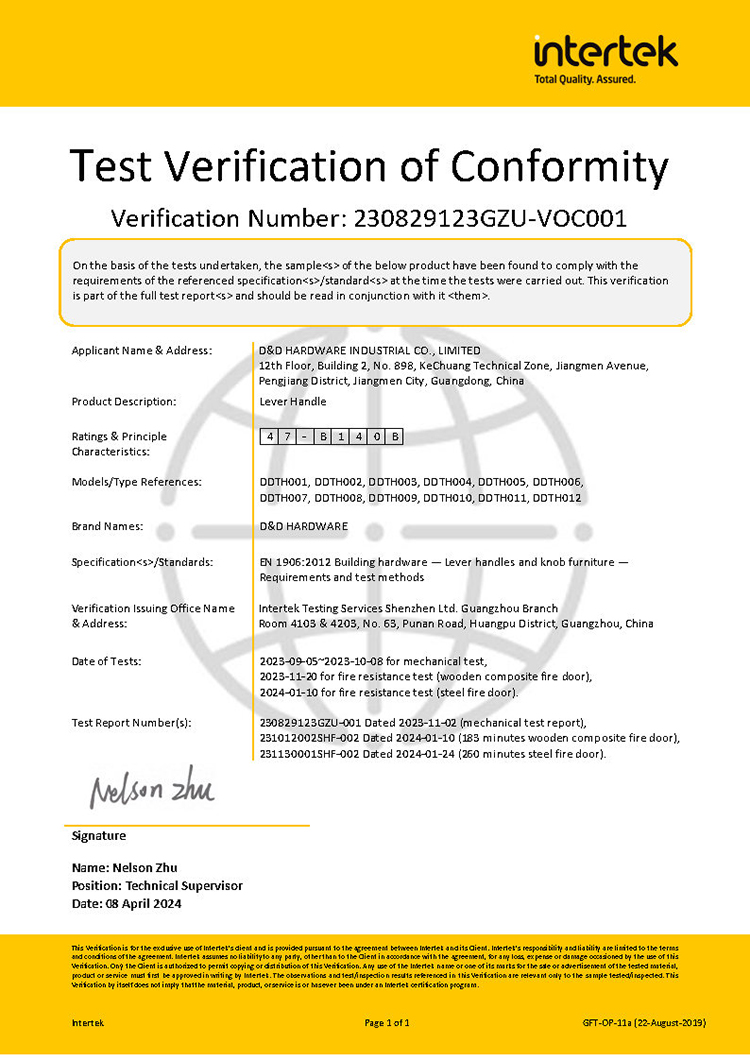
Safety protocols dictate that door hardware must perform flawlessly during emergencies. Fire-rated doors require handles that resist melting or deforming under extreme heat, ensuring occupants can quickly exit the building. Facilities must select hardware that carries UL or CE certifications, verifying their performance under fire conditions. Additionally, designs often incorporate a "return-to-door" lever shape. This inward-curving handle prevents bags, clothing, or fire hoses from catching on the hardware during an urgent evacuation.
Public sector buildings present unique challenges for hardware selection. A door handle for Government office environments must project a professional appearance while adhering strictly to national accessibility guidelines and stringent security protocols.
Every citizen needs unhindered access to public services. Therefore, door hardware must comply with the Americans with Disabilities Act (ADA) or equivalent regional disability access codes. Lever handles are universally preferred over round knobs because they do not require tight grasping, pinching, or twisting of the wrist. A simple downward push allows users with limited mobility, elderly visitors, or individuals carrying heavy items to open the door easily.
Government buildings house sensitive information and personnel. The hardware securing these spaces must integrate seamlessly with advanced mortise locks and electronic access control systems. Heavy-duty lever handles provide the necessary structural integrity to deter forced entry, offering peace of mind for facility managers and occupants alike. Solid escutcheon plates protect the locking cylinders from tampering, drilling, or physical attacks.

The base material of a door handle dictates both its lifespan and maintenance requirements. Commercial facilities predominantly rely on two specific metals to achieve the necessary balance of strength, weather resistance, and hygiene.
Stainless steel, particularly the SUS304 grade, dominates the commercial hardware market. This material provides exceptional resistance to corrosion, rust, and physical impact. For a public building door handle installed on an exterior entryway, stainless steel offers unparalleled weather resistance. Its smooth, non-porous surface makes it exceptionally easy to clean and sanitize, reducing the spread of germs in highly populated areas. Scratches and scuffs easily blend into brushed stainless finishes, maintaining a clean aesthetic for decades.
While stainless steel excels in sheer strength, brass offers a unique biological advantage. Unlacquered brass alloys possess natural antimicrobial properties, known as the oligodynamic effect. This characteristic allows the metal to actively destroy surface bacteria and viruses within hours of contact. Many healthcare facilities and public institutions choose brass handles to create an additional layer of passive hygiene for their patrons, helping to curb the transmission of seasonal illnesses.
Large institutional buildings frequently feature wide corridors, auditoriums, and grand entryways utilizing double doors. These setups require a specific approach to hardware selection to ensure both sides of the entryway function cohesively and securely.
A double door handle configuration typically pairs an active handle, which operates the primary latch or mortise lock, with a dummy or inactive handle on the secondary door. This arrangement maintains visual symmetry across the entryway while simplifying the locking mechanism. When outfitting double doors, it is crucial to ensure that both handles utilize the same robust mounting plates and heavy-duty through-bolt fixings. A weak mounting system on a heavy commercial double door will inevitably lead to loose hardware, rattling frames, and compromised building security.
Selecting the appropriate hardware for public facilities requires a deep understanding of durability standards, material science, and building codes. Whether you are upgrading a local clinic or specifying a door handle for Government office renovations, the right choice ensures long-term safety and seamless accessibility.
Review your facility's specific needs, consult regional building codes, and always prioritize hardware tested to rigorous commercial standards like BS EN1906 Grade 4. By investing in heavy-duty, meticulously engineered levers, you will reduce your facility's maintenance costs and provide a safer, more accessible environment for every visitor who walks through your doors.
Click here for additional details on door handles.
Now contact us.
Contact information for David Jian
Contact number: 0086-139 2903 7292
Email address: sales@danddhardware.com


