
Certified for Safety. Trusted by Leaders Worldwide.
Pls inquire to sales@danddhardware.com
\\: +86 139 2903 7292

 English
 Author: D&D Hardware Publish Time: 2026-04-09 Origin: D&D HARDWARE


Shopping malls and retail centers are among the most complex high-occupancy commercial environments, where thousands of visitors circulate daily across interconnected spaces. In such buildings, life safety is a top priority, and fire protection strategies must be carefully integrated into every architectural and operational detail.
One of the most critical yet often underestimated elements is fire-rated door hardware. While fire-rated doors themselves are designed to resist the spread of fire and smoke, their performance depends heavily on the correct specification and installation of hardware components.
This article focuses on mechanical fire-rated door hardware solutions—excluding smart or electronic systems—and provides a practical, application-based guide for door manufacturers, hardware brands, contractors, and mall operators involved in retail construction projects.

Retail environments present unique fire safety challenges that differ significantly from office buildings or residential projects:
1. High Pedestrian Traffic
Mall doors experience extremely high usage cycles, especially during peak hours, weekends, and promotional events. Hardware must withstand continuous operation without failure.
2. Multi-Tenant Layouts
Each tenant space may have different fire separation requirements, creating complex **fire compartmentation needs** across the building.
3. Open Atriums and Connected Spaces
Large open areas increase the risk of rapid smoke and heat spread, placing greater importance on fire-rated doors and properly functioning hardware systems.
4. Egress vs. Security Balance
Exit doors must allow immediate evacuation, while still maintaining security during normal operations.
5. Integration with Building Systems
Fire doors must work in coordination with sprinkler systems, alarms, and smoke control systems, requiring reliable mechanical hardware that performs independently of electrical systems.

A compliant fire-rated door assembly in a shopping mall is built on a system of certified mechanical hardware components.
Locks in retail environments must balance security and emergency egress:
* Mortise locks certified to UL 10C or EN12209 standards
* Cylindrical locks for lower-security applications
* Common functions:
* Storeroom function (locked externally, free egress internally)
* Classroom function for administrative spaces
Mechanical locks ensure fail-safe operation during emergencies, without reliance on power.


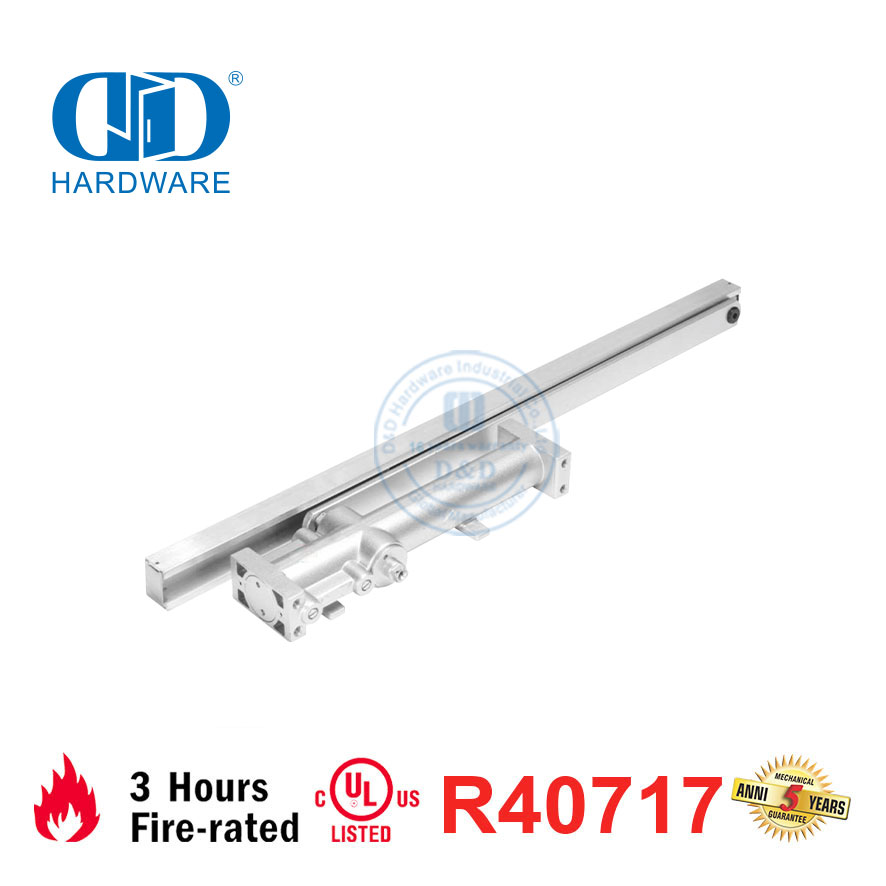
Closers are essential for ensuring that fire doors automatically return to the closed position:
* Certified to UL 10C or EN1154 standards
* Suitable for high-traffic doors in corridors and entrances
* Key features:
* Backcheck to prevent damage from sudden opening
* Delayed action for accessibility and goods movement
* Mounting options:
* Surface-mounted (durable and practical)
* Concealed (preferred for premium retail aesthetics)
* Parallel arm or top jamb mounting to reduce vandalism exposure

Hinges must support heavy doors and maintain alignment under extreme use:
* ANSI/BHMA Grade 1 hinges for high-cycle environments
* UL 10C listed or EN1935 certified butt hinges
* Stainless steel construction for durability and corrosion resistance
* Load and cycle tested for retail traffic conditions


Emergency exit hardware is critical in retail environments where rapid evacuation is required:
* Certified to UL 305, UL 10C, or EN1125
* Types: rim devices, mortise devices, surface vertical rod devices
* Dogging feature allows temporary hold-open during non-emergency periods
* No electric latch retraction or electronic trim to ensure reliability
These devices are widely used in main egress routes and large tenant spaces.


Sealing systems play a vital role in preventing the spread of fire and smoke:
* Intumescent seals expand under heat to seal door gaps
* Smoke seals limit early smoke migration
* Acoustic seals improve comfort in tenant spaces
* Often combined into integrated sealing systems for rated assemblies
Effective fire door hardware configuration in retail projects requires an application-based approach:
Main Mall Corridors & Common Egress Paths
* Panic exit devices for immediate evacuation
* Heavy-duty door closers for controlled closing
* High-strength hinges for continuous operation
Tenant Storefronts (Fire-Rated Partitions)
* Mortise locks with storeroom function
* Concealed closers for aesthetic consistency
* Intumescent seals for fire-rated wall integration
Stairwells & Fire Escape Routes
* Certified fire exit hardware
* Door closers with backcheck
* Smoke seals to maintain protected escape routes
Loading Docks & Service Corridors
* Corrosion-resistant hinges and hardware
* Heavy-duty bolts and reinforced locking systems
* Weather-resistant panic devices where applicable
Food Courts & Kitchen Areas
* Stainless steel hardware for hygiene and durability
* High-temperature intumescent seals
* Closers designed for frequent service traffic
Mall Offices & Management Areas
* Classroom or standard lock functions
* Fire-rated closers
* Privacy hardware where required
Compliance is essential in retail construction projects, especially for international developments. Fire-rated door hardware must align with:
* NFPA 80 – Standard for Fire Doors and Opening Protectives
* NFPA 101 – Life Safety Code (means of egress)
* IBC / CBC – Local building codes
* UL 10C – Positive pressure fire testing for door assemblies
* Proper labeling of fire-rated doors, frames, and hardware
Using certified hardware simplifies inspection, approval, and documentation processes.

Even high-quality hardware can fail if improperly installed or maintained. Common issues include:
* Mixing non-rated hardware with fire-rated doors
* Disabling door closers for convenience
* Using incorrect screws or fasteners
* Blocking or painting over intumescent seals
* Delayed maintenance in high-use areas
These mistakes can lead to code violations, safety risks, and costly rework.
To ensure long-term performance and compliance, the following best practices are recommended:
* Specify complete hardware kits from a single certified system
* Use Grade 1 mechanical hardware for high-traffic applications
* Conduct regular inspections (e.g., quarterly per NFPA 80 guidelines)
* Maintain detailed records of fire door assemblies and maintenance
* Educate tenants on proper use of fire doors (no propping open or modification)
For B2B stakeholders, providing standardized hardware solutions improves efficiency, reduces risk, and enhances project competitiveness.
Fire-rated door hardware is a non-negotiable life safety system in shopping malls and retail centers. In environments defined by high occupancy and constant movement, only certified, heavy-duty mechanical hardware can deliver the reliability required for both daily operation and emergency situations.
By adopting a system-based, application-driven approach, and ensuring compliance with international standards, door manufacturers, hardware brands, and contractors can deliver retail projects that are safe, durable, and fully compliant.
In modern retail architecture, fire-rated door hardware is not just a technical requirement—it is a critical component of the building’s safety infrastructure and long-term operational success.
Click here for additional details on fire rated door hardware.
Now contact us.
Contact information for David Jian
Contact number: 0086-139 2903 7292
Email address: sales@danddhardware.com


