
Certified for Safety. Trusted by Leaders Worldwide.
Pls inquire to sales@danddhardware.com
\\: +86 139 2903 7292

 English
 Author: D&D Hardware Publish Time: 2025-12-15 Origin: D&D HARDWARE


Is your front door sticking every time you open it? Or maybe you’ve noticed a draft creeping in because the door doesn't close tightly against the frame? These are common nuisances homeowners face, and often, the culprit isn't the door itself—it's the hinges. Over time, gravity, humidity, and regular use can cause exterior door hinges to shift, sag, or loosen, leading to misalignment.
Ignoring a misaligned door can lead to bigger problems down the road. You might find yourself struggling with a lock that won't engage, weatherstripping that wears out prematurely, or even damage to your flooring. The good news is that adjusting exterior door hinges is a manageable DIY project that doesn't require expensive tools or a professional carpenter.

In this guide, we will walk you through the signs of misaligned hinges, the tools you'll need, and step-by-step methods to get your door swinging smoothly again.
Before you grab your screwdriver, it helps to confirm that the hinges are indeed the problem. Sometimes, humidity can cause wood to swell, which mimics alignment issues. However, if the issue persists across seasons, check for these tell-tale signs:
Close the door and inspect the gap between the door slab and the frame. The space should be uniform all the way around. If you see a wider gap at the top than at the bottom (or vice versa), your door is hanging crookedly.
Does the top corner of the door rub against the jamb? This is a classic sign of a sagging door, often caused by loose top hinges unable to support the door's weight. Conversely, if the door rubs near the floor or the threshold, the lower hinge might need attention.
If you have to push, pull, or lift the door handle to get the deadbolt or latch to click into place, the alignment is off. The strike plate and the latch bolt are no longer meeting where they should.
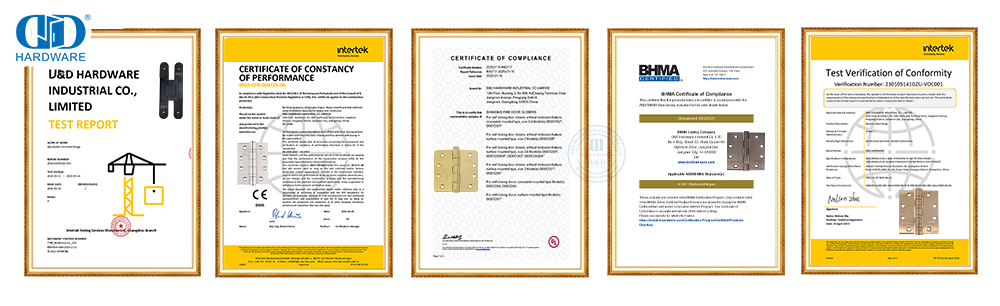
D&D CE / UL / ANSI / BHMA Door Hinge
✔️ Door Hinge-BS EN1935 200,000 cycles test, EN1634 Fire Rated 192mins/260mins, EN1670 Corrosion Resistance 240 hours.
✔️ Concealed Hinge-BS EN1935 200,000 cycles test, EN1634 Fire Rated 132mins, EN1670 Corrosion Resistance 48 hours.
✔️Door Hinge-UL/cUL UL 10C Fire Rated 3 Hours, File No.R38013 & ANSI/BHMA Grade1&Grade 2
You likely already have everything required for this job in your garage or junk drawer. To adjust exterior door hinges effectively, gather the following:
Screwdriver: A manual Phillips head screwdriver is often better than a drill to avoid stripping screws.
3-inch wood screws: These are crucial for replacing short factory screws that don't bite into the stud.
Allen wrench (Hex key): Required for adjustable hinges.
Level: To check for plumb.
Shims or thin cardboard: For propping up the door during work.
Hammer and nail set: Useful if you need to remove hinge pins.
Adjustable wrench: For bending hinge knuckles (a more advanced method).
1
The simplest fix is often the right one. Heavy exterior doors put significant strain on screws, causing them to back out over time.
Inspect the screws: Open the door wide and look at the mounting screws on both the door slab and the jamb side of the hinge.
Tighten them up: Using your screwdriver, hand-tighten any screw that appears loose. Be careful not to over-tighten, which can strip the wood.
Check the fit: Close the door to see if the alignment has improved.
If tightening the screws didn't work—or if they just spin without gripping—the screw holes are likely stripped, or the screws are too short to reach the framing stud behind the jamb. This is the most effective way to fix a sagging door.
Remove the center screw: On the top hinge, remove the center screw from the jamb side.
Insert a long screw: Replace it with a 3-inch wood screw. This length allows the screw to pass through the door jamb and anchor solid into the structural stud of the wall.
Tighten slowly: As you tighten this long screw, watch the door. You should see it pull closer to the jamb, lifting the sagging side.
Repeat if necessary: If the door still sags, you can replace additional screws in the top hinge, or move to the middle hinge.
Many modern exterior doors come equipped with adjustable hinges. These are a lifesaver because they allow you to move the door vertically or horizontally without removing screws.
Locate the adjustment screws: Look for hex-head screws located in the center of the hinge knuckle or on the face of the hinge leaves.
Vertical adjustment: To raise or lower the door, turn the vertical adjustment screw. Usually, turning clockwise raises the door, while counter-clockwise lowers it. It is best to adjust all hinges equally to distribute the weight.
Horizontal adjustment: If the gap on the side is uneven, use the horizontal adjustment screw. This will move the door closer to or further away from the hinge side jamb.
Test frequently: Make small turns (1/4 turn at a time) and close the door to check your progress.
If your screws are tight but the door is still crooked, you may need to add shims behind the hinge plate to push the door into alignment.
Loosen the hinge: Loosen the screws on the door jamb side of the hinge that needs adjustment. You don't need to remove them completely, just enough to create a gap.
Insert the shim: Slide a thin piece of cardboard (like from a cereal box) or a plastic shim behind the hinge plate.
Tighten and test: Retighten the screws. The shim will push the hinge plate out slightly, altering the angle of the door.
To fix rubbing at the top of the lock side: Shim the bottom hinge.
To fix rubbing at the bottom of the lock side: Shim the top hinge.
This is an old-school carpenter's trick for doors that don't have adjustable hinges and where shimming hasn't worked perfectly. It involves physically bending the hinge to close the gap.
Remove the hinge pin: Use a hammer and nail set to pop the pin out of the problem hinge.
Bend the knuckles: Use an adjustable wrench to slightly bend the knuckles on the door side of the hinge. Bend them toward the lock side of the door to close the hinge gap, or away to widen it.
Reassemble: Replace the pin and check the fit. This method requires finesse; too much bending can damage the hinge.

Look closely at the hinge while the door is open. Standard hinges just have smooth knuckles and screw heads visible on the leaves. Adjustable exterior door hinges will have set screws, often accommodating an Allen wrench (hex key), located either on the top/bottom of the pin area or horizontally on the hinge face. They may also have small + or - indicators stamped into the metal.
While WD-40 is great for loosening stuck parts, it isn't the best long-term lubricant for hinges. It can attract dust and eventually gum up. Instead, use a silicone spray or white lithium grease. These provide smoother operation and last longer without attracting dirt.
If your door swings open or shuts without you touching it, the door frame is likely not plumb (perfectly vertical). While adjusting the hinges can help with friction, fixing a "ghost" door often involves bending the hinge pin slightly to create more friction or reinstalling the hinges with shims to correct the plumb line.

Adjusting exterior door hinges is one of those home maintenance tasks that offers a high reward for relatively little effort. A properly aligned door not only stops that annoying squeak or scrape but also ensures your deadbolt engages securely and your weatherstripping seals out the elements.
By following these steps, you can extend the life of your door and avoid the cost of a full replacement. If you have tried these methods and the door still won't close properly, the issue might be with the structural framing of your house, at which point calling a professional is the best course of action. But for most sagging or sticking doors, a few turns of a screwdriver is all it takes to restore order to your entryway.
Click here for additional details on door hinges.
Now contact us.
Contact information for David Jian
Contact number: 0086-139 2903 7292
Email address: sales@danddhardware.com


