
Certified for Safety. Trusted by Leaders Worldwide.
Pls inquire to sales@danddhardware.com
\\: +86 139 2903 7292

 English
 Author: D and D Hardware Publish Time: 2026-03-18 Origin: D and D Hardware


Every single day, hundreds of students, teachers, and staff members interact with the doors in a school building. These touchpoints endure constant pushing, pulling, and occasional roughhousing. Standard residential or light-commercial hardware simply cannot survive this level of continuous stress.
Administrators face a unique challenge when upgrading or maintaining facility hardware. They must balance strict safety codes with extreme durability requirements. A broken lock or jammed lever is not just an inconvenience in a school environment. It easily becomes a severe safety hazard during a lockdown or fire emergency.
Selecting the right door handle for Educational Institution environments requires careful consideration of materials, accessibility laws, and fire safety ratings. By understanding the specific needs of these bustling environments, facility managers can make informed decisions that protect both their maintenance budgets and their students.
Schools are unique ecosystems. Hardware installed in these buildings faces a level of wear and tear rarely seen in other commercial spaces.
A standard classroom door might open and close dozens of times within a single hour. Multiply that by the length of a school year, and you have thousands of operational cycles. If an eduction door handle lacks the internal mechanisms to support high-frequency use, the springs will quickly fail. This leaves doors unable to latch securely, compromising classroom security. Heavy-duty commercial hardware is specifically engineered to handle millions of cycles without losing tension or structural integrity.
Students are not always gentle with school property. Backpacks get caught on levers, doors are kicked open, and handles are sometimes subjected to intentional tampering. A reliable school door handle must feature a vandal-resistant design. This often means utilizing heavy-duty internal chassis components and tamper-proof mounting screws. By installing robust hardware, schools drastically reduce the frequency of repair requests and lower overall maintenance costs.

While durability keeps maintenance costs low, safety features save lives. Educational facilities must comply with strict building codes to ensure everyone can evacuate quickly during an emergency.
During a fire alarm or emergency evacuation, panic can set in quickly. Students and staff need to exit the building without fumbling with complex locks or sticky door handles. Hardware must allow for a single-motion egress. This means that even if a door is locked from the outside to prevent intruders from entering, turning the inside lever must immediately unlatch the door.
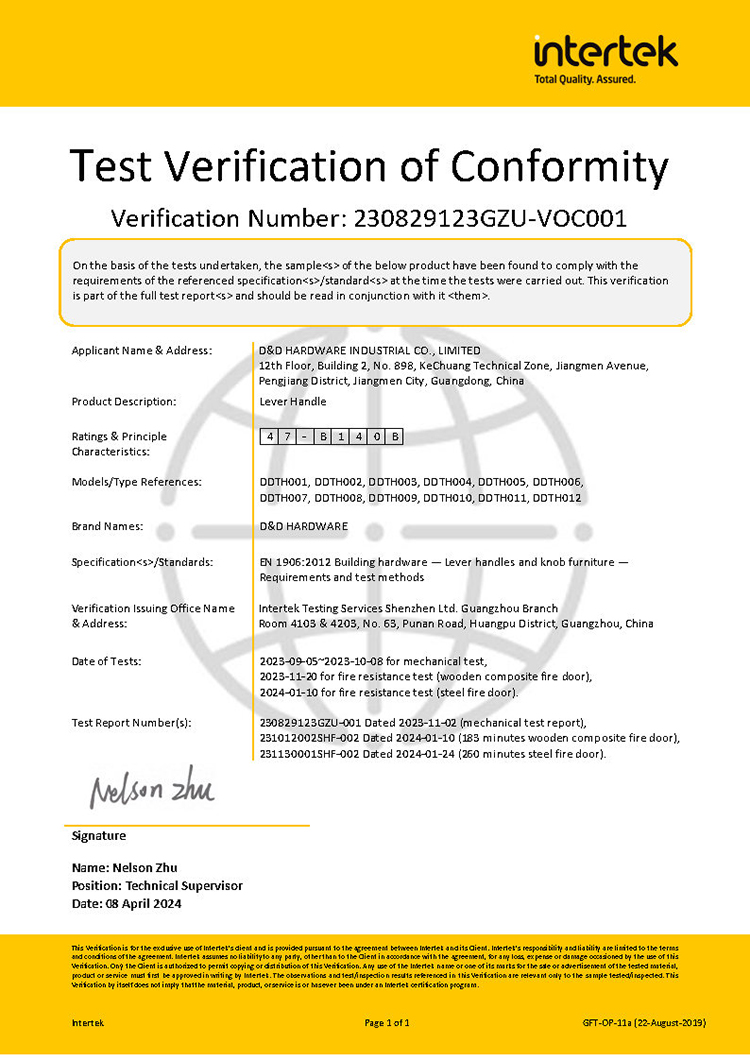
Doors located in stairwells, corridors, and specific hazardous rooms must act as barriers to smoke and fire. A fire-rated door is only effective if its hardware is equally resilient. Lever handles and locks used in these zones must be tested and certified to withstand extreme temperatures without melting or failing. This ensures the door remains securely latched, containing the fire and giving occupants precious time to escape.
D&D Door Handle-BS EN1906 300,000 cycles test, EN1634 Fire Rated 183/260mins, EN1670 Corrosion Resistance 240 hours.
Accessibility is a fundamental requirement in modern educational facility design. Every student, regardless of physical ability, deserves equal access to classrooms, restrooms, and administrative offices.
The Americans with Disabilities Act (ADA) mandates that door hardware must be easy to grasp with one hand. It cannot require tight grasping, tight pinching, or twisting of the wrist to operate. This legislation effectively made traditional round door knobs obsolete in public buildings. Heavy-duty lever handles provide the perfect solution. They allow users to open doors using a closed fist, an elbow, or a simple downward push.
Installing a lever handle is only the first step toward compliance. The hardware must also operate smoothly without requiring excessive force. If a lever is too stiff, younger students or those with mobility impairments may still struggle to enter a room. High-quality commercial hardware features precision-engineered springs that offer the perfect balance between a secure latch and easy operation.

When evaluating materials for school hardware, stainless steel consistently ranks as the superior choice.
Schools require frequent cleaning and sanitation, especially in high-touch areas like door hardware. Custodial teams use strong chemical disinfectants to stop the spread of illnesses. Over time, these chemicals can strip the finish off lesser metals, leading to rust and degradation. Stainless steel handles resist corrosion naturally. They maintain their structural integrity and appearance even after years of exposure to harsh cleaning agents.
Stainless steel is non-porous, making it difficult for bacteria and grime to hide on the surface. This contributes to a healthier school environment. Additionally, a sleek brushed stainless steel finish provides a clean, professional aesthetic that elevates the look of the entire facility. It resists visible scratching and fading, ensuring the school looks well-maintained for years to come.
Upgrading your facility's hardware is a critical investment in student safety and operational efficiency. You need products that meet strict international certifications, including CE, UL, ANSI, and BHMA standards.
D&D Hardware specializes in manufacturing stable, reliable, and heavily certified commercial door hardware. With nearly two decades of expertise, they provide heavy-duty stainless steel lever handles, fire-rated locks, and panic exit devices designed specifically for high-traffic public buildings.
If you are planning a school renovation or need to replace failing hardware, do not compromise on quality. Explore the extensive range of certified architectural hardware at https://www.dnd-hardware.com/ to find the perfect durability and safety solutions for your educational institution.
Click here for additional details on door handles.
Now contact us.
Contact information for David Jian
Contact number: 0086-139 2903 7292
Email address: sales@danddhardware.com


